English
Da Nang is often described as one of Vietnam’s best-value beach destinations—but how much does a trip to Da Nang actually cost?
The answer can be surprisingly different from one traveler to another.

A solo backpacker staying in a hostel, eating local food, and spending afternoons at My Khe Beach can explore Da Nang on a relatively small budget. A couple staying in a comfortable beachfront hotel and taking private day trips will spend considerably more. Meanwhile, families and groups may find that private transportation becomes surprisingly economical once the cost is divided among several passengers.
The important thing is not simply asking:
“Is Da Nang cheap?”
A much more useful question is:
“How much should I budget for Da Nang based on the way I actually want to travel?”
This complete Da Nang travel budget guide breaks down accommodation, food, transportation, attractions, day trips, airport transfers, and other everyday expenses so you can build a realistic budget before arriving.
Quick Answer: How Much Money Do You Need Per Day in Da Nang?
As a general planning estimate, international visitors can think about their daily spending in three broad categories.
| Travel Style | Estimated Daily Budget per Person | Best For |
|---|---|---|
| Budget | 600,000–1,000,000 VND | Backpackers, solo travelers |
| Mid-range | 1,200,000–2,500,000 VND | Couples, most independent travelers |
| Comfortable | 2,500,000–4,000,000 VND | Families, couples wanting more comfort |
| Luxury | 4,000,000 VND+ | Resort stays, premium experiences |
These are planning estimates rather than fixed prices.
Your actual spending can change considerably depending on whether your day involves relaxing at the beach or visiting a major paid attraction such as Ba Na Hills.
Accommodation also makes a major difference. Two travelers can follow almost exactly the same itinerary but have completely different trip costs simply because one chooses a basic hotel while the other stays at a luxury beachfront resort.

If this is your first visit, our Da Nang Travel Guide 2027 can help you understand the destination before building your budget.
What Determines the Cost of a Da Nang Trip?
Your total Da Nang trip cost is usually made up of six main categories:
- Accommodation
- Food and drinks
- Local transportation
- Entrance tickets and activities
- Day trips outside Da Nang
- Shopping and personal expenses
There is also one factor travelers sometimes underestimate: how efficiently the itinerary is planned.
Visiting attractions in a logical geographical order can save both time and transportation costs.
For example, combining Marble Mountains with Hoi An makes more sense than returning to your Da Nang hotel between the two destinations.
Similarly, Hai Van Pass and Lang Co can naturally be combined because they are located along the same northern route.
Good itinerary planning therefore isn’t just about seeing more—it can also help you spend less.
1. Accommodation: How Much Does a Hotel in Da Nang Cost?
Da Nang has one of the widest accommodation ranges in Central Vietnam.
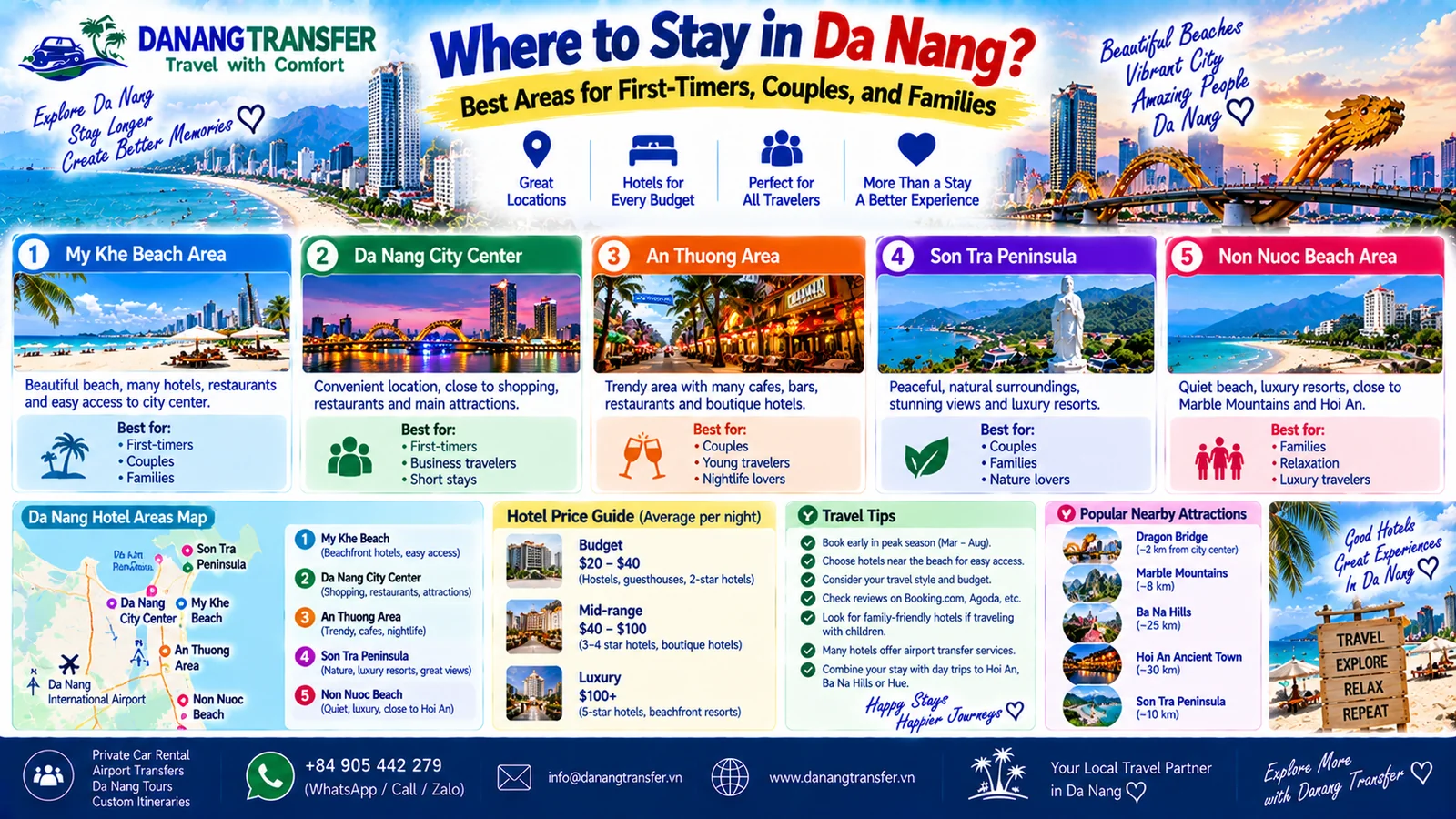
Discover the best areas to stay in Da Nang, including My Khe Beach, Da Nang City Center, An Thuong, Son Tra Peninsula and Non Nuoc Beach.
You can find everything from inexpensive hostel beds and local guesthouses to international beachfront resorts.
Budget Accommodation
Budget travelers have many options, particularly away from the most expensive beachfront properties.
You can consider:
- Hostel dormitories
- Guesthouses
- Small local hotels
- Budget apartments
- Homestays
For solo travelers, hostels have another advantage: they make it easier to meet other travelers and potentially share transportation or activities.
See our Top Da Nang Hostels & Homestays for Budget Travelers for more ideas.
Mid-Range Hotels
This is arguably where Da Nang offers some of its best value.
The city has a large number of 3-star and 4-star hotels offering facilities such as:
- Air conditioning
- Private bathrooms
- Swimming pools
- Breakfast
- Wi-Fi
- Reception
- Luggage storage
- Beach access or short walking distance to the coast
Couples and families who don’t need resort-level facilities can often find very comfortable accommodation without moving into the luxury price category.
Luxury Hotels and Beach Resorts
Da Nang’s coastline is home to premium hotels, luxury villas, and internationally recognized resorts.
This category is especially popular with:
- Honeymooners
- Families
- Anniversary travelers
- Luxury travelers
- Guests wanting a resort-focused holiday
Your accommodation budget can increase significantly here, especially during Vietnamese public holidays, international events, summer, Christmas/New Year, and other high-demand periods.
Before choosing your hotel, read Where to Stay in Da Nang: Best Areas for First-Timers, Couples and Families.
2. Beach Area or City Center: Which Is Better for Your Budget?
Hotel location affects more than your room rate.
It also affects how much you spend getting around.
Staying Near My Khe Beach
This area is convenient for travelers who prioritize:
- Beach time
- Seafood
- Cafés
- Restaurants
- Relaxed evenings
- Easy access toward Hoi An
You may pay more for certain beachfront properties, but you can also save money by walking to restaurants and the beach.
Staying Near the City Center
The city side of the Han River can be convenient for:
- Markets
- Local food
- Shopping
- Han River
- Dragon Bridge
- City sightseeing
Accommodation can sometimes offer better value away from the immediate beachfront.
The right choice depends on your itinerary—not simply which room is cheaper.
3. Food Budget: Is Eating in Da Nang Expensive?
For many visitors, food is one of the best-value parts of traveling in Da Nang.
The city has an enormous range of dining options, from inexpensive local eateries to premium seafood restaurants and international dining.
Local Vietnamese Meals
Travelers trying to keep costs low should eat where local residents eat.
Popular Da Nang dishes include:
- Mi Quang
- Bun cha ca
- Banh xeo
- Nem lui
- Banh mi
- Com ga
- Bun thit nuong
- Seafood
A local breakfast and lunch can cost dramatically less than eating every meal at international restaurants near tourist areas.
More importantly, eating locally is not merely a budgeting strategy—it is part of the travel experience.
Explore our Da Nang Must-Try Foods & Local Restaurants Guide before your trip.
Coffee and Cafés
Vietnamese coffee culture is another experience you don’t need a huge budget to enjoy.
Try:
- Vietnamese iced coffee
- Coconut coffee
- Salt coffee
- Fresh fruit juice
- Smoothies
Modern specialty cafés generally cost more than traditional neighborhood coffee shops, but both remain accessible to most travelers.
International Restaurants
Da Nang has plenty of:
- Indian restaurants
- Korean restaurants
- Japanese restaurants
- Western restaurants
- Pizza
- Burgers
- Vegetarian restaurants
If you eat primarily international food, your daily food budget will naturally be higher than someone eating mainly Vietnamese meals.
Seafood: Check Prices Before Ordering
Da Nang is famous for seafood, but this is one area where your dinner bill can vary enormously.
Some restaurants sell seafood by weight.
Before ordering, confirm:
- Price per kilogram
- Weight
- Cooking method
- Any preparation charges
This is particularly useful when ordering lobster, crab, prawns, shellfish, or premium fish.
4. Transportation: One of the Most Important Parts of Your Da Nang Budget
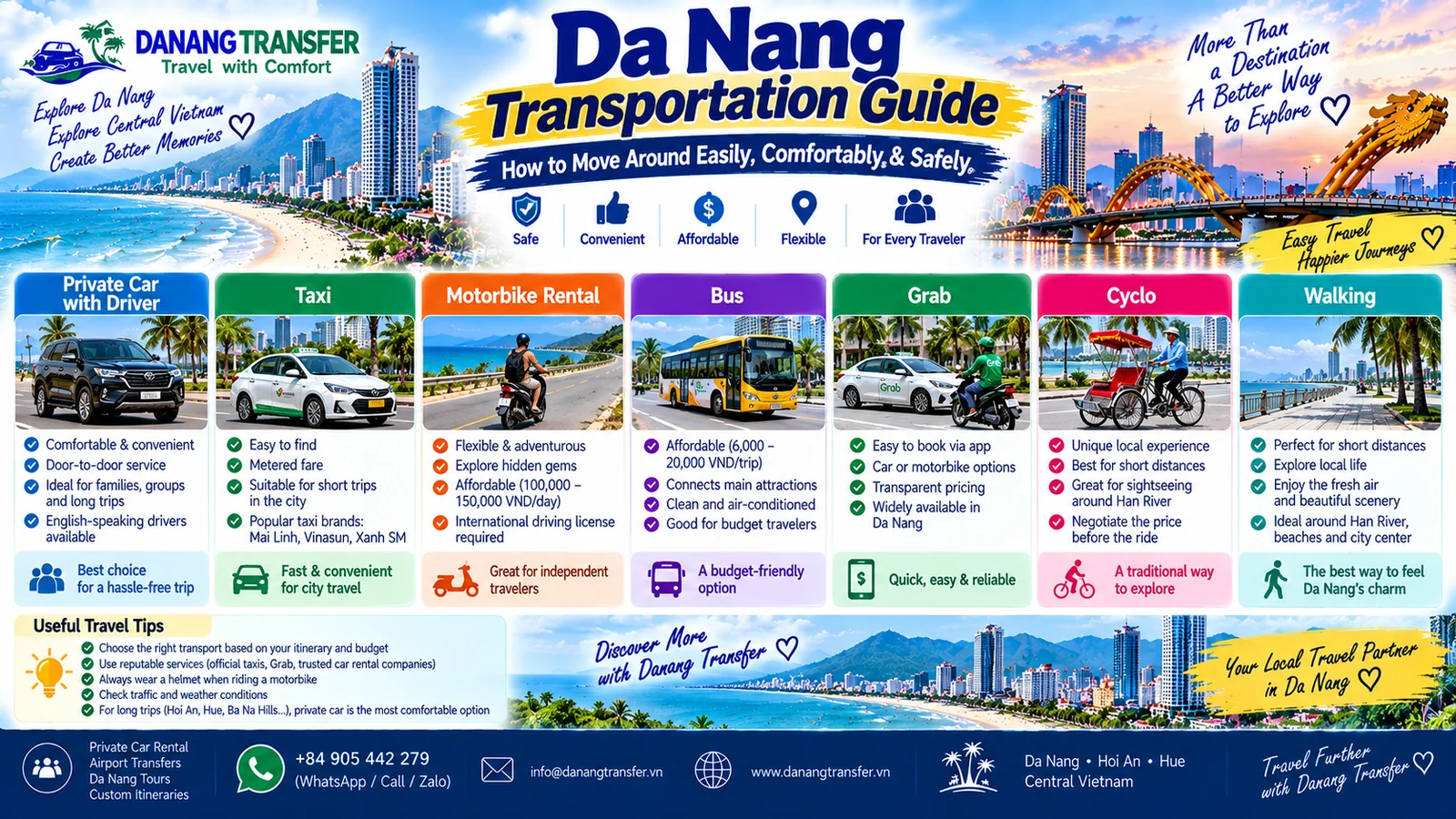
Da Nang transportation guide covering the best ways to get around the city, including private cars, taxis, Grab, buses, motorbikes, cyclo and walking.
Transportation is where trip budgets often become difficult to compare.
Why?
Because travelers aren’t necessarily buying the same service.
A short Grab ride within Da Nang and a private vehicle waiting for you during a full-day sightseeing itinerary are completely different products.
The cheapest transportation option therefore depends on where you’re going and how many stops you have.
Read our complete Da Nang Transportation Guide if you want to compare the main options.
5. Walking: Free but Limited
Walking is obviously the cheapest transportation option.
It works particularly well around:
- My Khe Beach
- Han River
- Dragon Bridge
- Local restaurant areas
- Night markets
- Compact neighborhoods
However, Da Nang is spread over a relatively large area.
You cannot realistically walk between all major attractions.
Marble Mountains, Son Tra Peninsula, Ba Na Hills, Hoi An, Hai Van Pass, and Hue all require transportation.
6. Grab and Taxi: Best for Short City Trips
For short trips, taxis and ride-hailing services can be very convenient.
They work well for journeys such as:
Hotel → restaurant → hotel
or
Hotel → shopping mall
or
Hotel → Dragon Bridge
You pay for individual journeys and don’t need a vehicle waiting for you.
This makes them especially practical for travelers who mostly stay within Da Nang.
However, the calculation changes when your itinerary includes multiple distant attractions.
Five or six individual rides, waiting for vehicles in remote locations, and traveling with luggage can make a private transfer more practical.
7. Scooter Rental: Cheap, but Is It Right for You?
Some independent travelers consider renting a scooter because of its flexibility and relatively low daily cost.
But price should not be the only consideration.
You also need to think about:
- Traffic experience
- Weather
- Local driving conditions
- Valid licensing requirements
- Insurance
- Parking
- Navigation
- Long-distance comfort
A scooter may work well for an experienced rider, but it isn’t automatically the best option simply because it appears cheaper.
Our Best Ways to Explore Danang: Rent a Scooter, Car or Use Grab? compares these choices in more detail.
8. Private Car With Driver: When Does It Make Financial Sense?
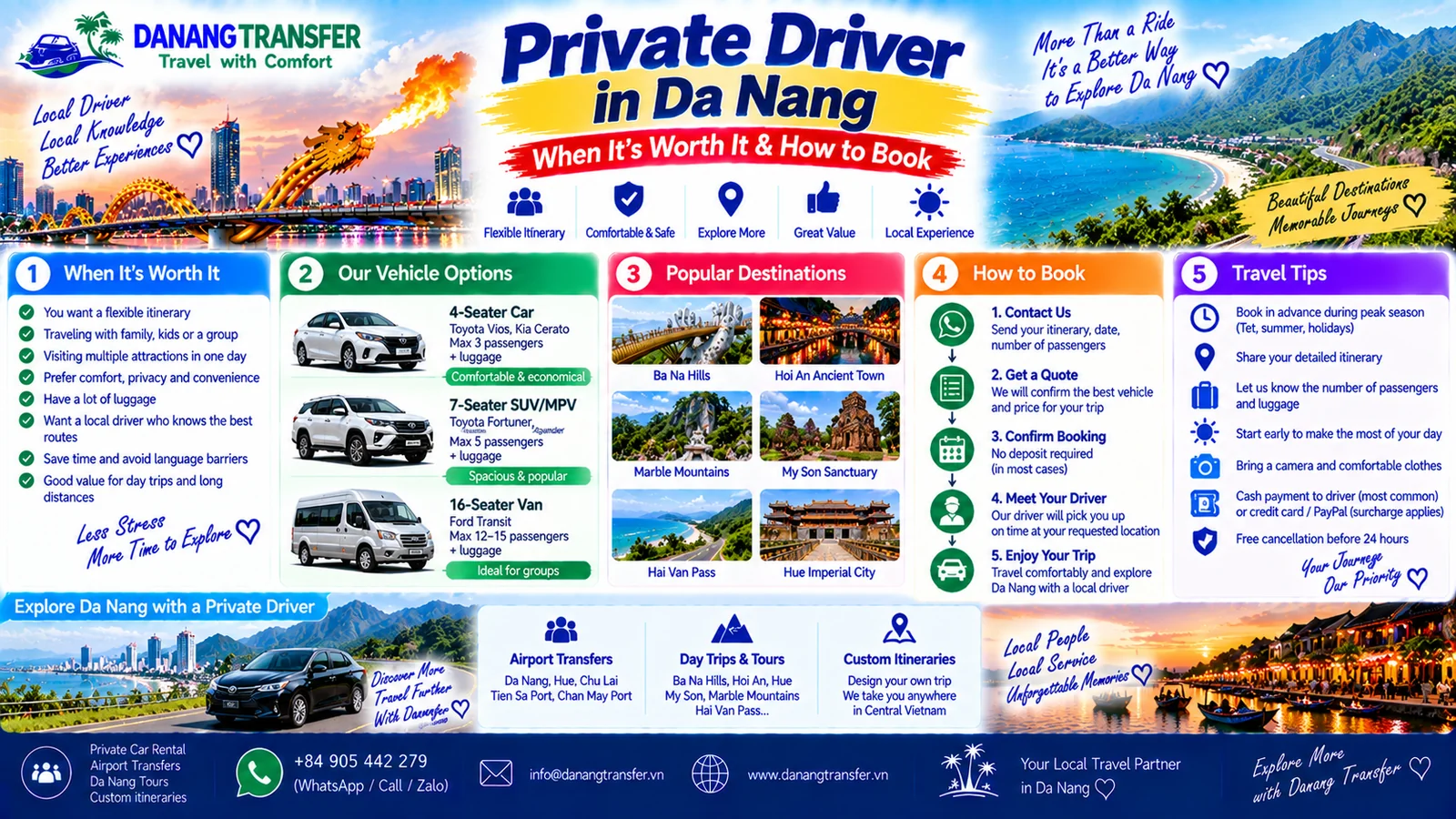
Private driver in Da Nang guide explaining when to hire a private car, available vehicle options, popular destinations and how to book.
A private car is not necessarily the cheapest option for a single short journey.
But it can offer good value for:
- Families
- Couples
- Groups
- Travelers with luggage
- Senior travelers
- Full-day sightseeing
- Multiple-stop itineraries
- Long-distance transfers
Instead of arranging transport separately after every attraction, you have one vehicle following the agreed itinerary.
A private car can include hotel pickup, sightseeing stops, waiting time according to the booked service, and direct return to your accommodation.
For available routes, visit our Da Nang Private Car Service.
9. Da Nang Airport Transfer: What Should You Budget?

Pre-book a Da Nang Airport private car for comfortable door-to-door transportation with suitable vehicles for families, groups and travelers with luggage.
Da Nang International Airport is conveniently located close to central Da Nang.
This is good news for travelers because airport transportation does not require a long journey if your hotel is in the city.
However, your transfer cost depends on:
- Hotel location
- Vehicle size
- Passenger count
- Luggage
- Arrival time
- Whether you’re traveling to Da Nang or another destination
A traveler heading from Da Nang Airport to Hoi An, for example, should expect to spend more than someone staying in central Da Nang.
You can learn more in our Da Nang Airport Transportation guide.
For hotels within Da Nang, see Transfer from Da Nang Airport to Your Hotel in Da Nang.
10. Attraction Costs: What Should You Pay For?
One of the advantages of Da Nang is that you can combine expensive attractions with completely free experiences.
This makes it easier to balance your budget.
Some days may cost very little.
Others—particularly Ba Na Hills—will require a much larger sightseeing budget.
Let’s look at the major options.
11. My Khe Beach: One of Da Nang’s Best Free Experiences
You don’t need to pay an entrance fee simply to enjoy one of Da Nang’s biggest attractions.

My Khe Beach is perfect for:
- Sunrise
- Swimming
- Walking
- Photography
- Relaxing
- Evening strolls
You may spend money on food, drinks, beach facilities, or transportation, but enjoying the beach itself can be one of the cheapest activities in your itinerary.
See our Da Nang Beaches Guide.
12. Son Tra Peninsula: Big Experience, Relatively Small Budget

Son Tra Peninsula offers forests, viewpoints, coastal scenery, and Linh Ung Pagoda.
Your main expense is generally transportation.
Because Son Tra is close to Da Nang, it can be incorporated into a city sightseeing itinerary.
If you prefer a private vehicle, see Private Car Da Nang to Son Tra Peninsula.
13. Marble Mountains: Affordable and Easy to Combine With Hoi An
Marble Mountains is located south of central Da Nang on the way toward Hoi An.

This makes it particularly useful from a budget-planning perspective.
Instead of making two completely separate journeys, you can visit Marble Mountains before continuing to Hoi An.
The attraction offers:
- Caves
- Pagodas
- Viewpoints
- Stone stairways
- Cultural sites
Read our Marble Mountains Complete Guide before visiting.
14. Ba Na Hills: Usually One of the Most Expensive Sightseeing Days
Ba Na Hills and the Golden Bridge are among Da Nang’s best-known attractions.

They are also likely to represent one of the larger expenses in your itinerary.
You should budget separately for:
- Transportation
- Admission/cable car ticket
- Food
- Drinks
- Optional experiences
Because Ba Na Hills is outside central Da Nang, transportation also needs to be planned in advance.
Read our Ba Na Hills & Golden Bridge Travel Guide.
For transportation, see Private Car from Da Nang to Ba Na Hills.
Budget Tip
Don’t automatically judge Ba Na Hills by the entrance fee alone.
It is usually a long sightseeing day, so think about the cost per full-day experience rather than comparing it with a single city attraction.
15. Hoi An: How Much Should You Budget for a Day Trip?

Hoi An is close enough to Da Nang to visit without changing hotels.
This can actually save money.
Instead of paying for:
- Another hotel
- Luggage transfer
- Additional check-in/check-out logistics
you can keep your Da Nang hotel and visit Hoi An as a day or evening trip.
Typical expenses include:
- Transportation
- Ancient Town admission where applicable
- Food
- Coffee
- Shopping
- Lantern boat
- Coconut Village
- Tailoring
- Souvenirs
For transportation, see Private Car Transfer from Da Nang to Hoi An.
For an evening visit with return transportation, see Da Nang to Hoi An Round Trip by Private Car.
16. Hai Van Pass and Lang Co: Scenic Travel Without a Major Theme-Park Ticket

If scenery is more important to you than amusement attractions, Hai Van Pass can offer excellent value.
The journey gives you:
- Mountain scenery
- Coastal views
- Photo stops
- Hai Van Gate
- Views toward Da Nang and Lang Co
It can also be combined with Lang Co and Lap An Lagoon.
This means much of the experience comes from the journey itself rather than expensive entrance tickets.
See Transfer from Da Nang to Hai Van Pass by Private Car.
17. Hue: A Higher-Cost Day Trip, but Much More Than a Transfer
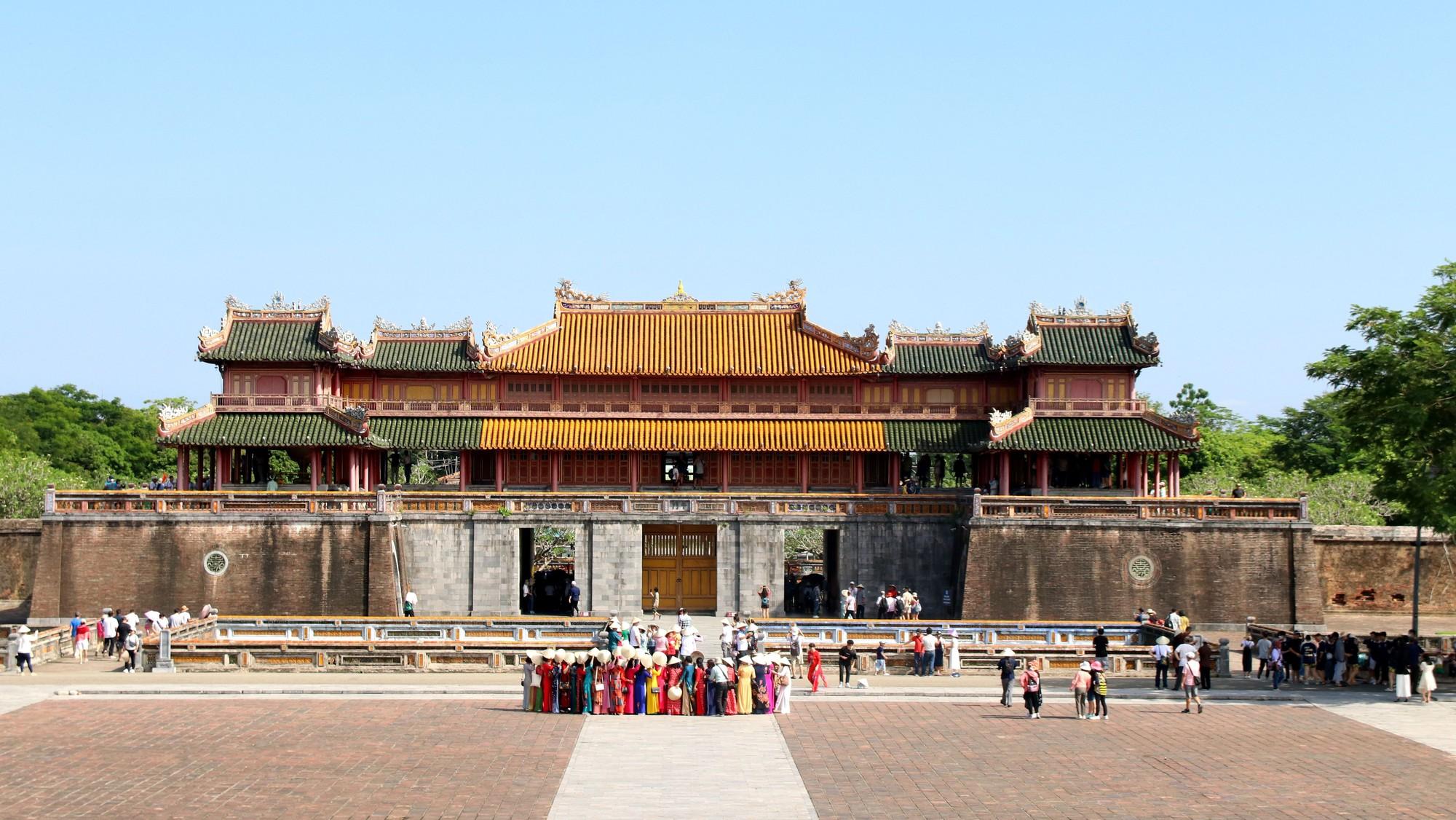
Hue is farther from Da Nang, so transportation costs are naturally higher.
However, the journey can become part of the sightseeing experience.
A scenic itinerary can follow:
Da Nang → Hai Van Pass → Lang Co → Hue
Once in Hue, visitors may explore:
- Imperial City
- Thien Mu Pagoda
- Royal tombs
- Local cuisine
- Historic neighborhoods
Instead of viewing the journey purely as transportation, think of it as a combination of scenic travel and sightseeing.
See Da Nang to Hue Day Trip by Private Car.
Our Da Nang to Hue Day Trip: Hai Van Pass Scenic Route Explained also helps with itinerary planning.
18. My Son Sanctuary: A Good Half-Day or Combined Excursion

My Son Sanctuary is another popular excursion from Da Nang.
Travelers interested in history, architecture, and Cham culture may find it worthwhile.
To use your transportation budget more efficiently, My Son can sometimes be incorporated into a broader itinerary rather than treated as a completely separate travel day.
For transportation information, see Transfer from Da Nang to My Son by Private Car.
19. Free Things to Do in Da Nang
This is where Da Nang performs particularly well as a budget destination.
You can build entire sections of your itinerary around activities requiring little or no admission cost.
Consider:
- My Khe Beach
- Sunrise at the beach
- Han River
- Dragon Bridge
- Local neighborhoods
- Markets
- Linh Ung Pagoda
- Coastal viewpoints
- Evening walks
The Dragon Bridge Fire Show can also be a memorable evening experience when the show is scheduled.
A smart itinerary mixes these experiences with paid attractions.
20. Sample 3-Day Da Nang Budget Strategy
Instead of looking only at daily spending limits, it is useful to think about expensive days and inexpensive days.
Day 1 – Low-Cost Da Nang City Day
Morning
Arrive in Da Nang and check into your hotel.
Visit My Khe Beach and explore the surrounding area.
Afternoon
Visit Son Tra Peninsula and Linh Ung Pagoda.
Evening
Explore Han River, Dragon Bridge, and a night market.
Main Expenses
- Airport transportation
- Food
- Local transportation
- Hotel
Many of the sightseeing experiences themselves are free.
Day 2 – Higher-Cost Ba Na Hills Day
Travel to Ba Na Hills in the morning.
Spend approximately half or most of the day exploring the complex and Golden Bridge.
Main Expenses
- Private car or other transportation
- Admission/cable car
- Food
- Drinks
- Optional activities
This is likely to be the most expensive day of the three.
Day 3 – Moderate-Cost Hoi An Day
Enjoy Da Nang during the morning.
In the afternoon, travel toward Hoi An, optionally stopping at Marble Mountains.
Spend the late afternoon and evening exploring Hoi An Ancient Town.
Return to Da Nang at night.
Main Expenses
- Transportation
- Marble Mountains admission if applicable
- Hoi An activities
- Dinner
- Optional lantern boat
- Shopping
This strategy creates a balanced trip:
Low-cost day → expensive day → moderate-cost day
That is often more realistic than trying to maintain exactly the same spending limit every day.
21. Sample 5-Day Da Nang Budget Strategy
With five days, you can slow down and avoid trying to fit every paid attraction into a short period.
A balanced itinerary might look like:
Day 1
Da Nang City + My Khe Beach + Dragon Bridge
Day 2
Ba Na Hills + Golden Bridge
Day 3
Marble Mountains + Hoi An
Day 4
Hai Van Pass + Lang Co
Day 5
Relaxation + shopping + airport transfer
For itinerary inspiration, see our Da Nang 5-Day Itinerary.
22. Da Nang Budget for Solo Travelers
Solo travel creates an interesting budget trade-off.
Accommodation and food can be very inexpensive, but transportation costs cannot be divided among other passengers.
For this reason, solo travelers should consider mixing transportation types.
For example:
- Walk around compact neighborhoods
- Use Grab for short journeys
- Use private transportation only for selected longer trips
- Join activities when they offer better value
- Stay near the area you plan to explore most
Solo travelers should read our complete Da Nang Travel Guide for Solo Travelers: Safety, Budget & Transport.
23. Da Nang Budget for Couples
Couples often have more flexibility because hotel and private transportation costs are shared between two people.
A typical couple may choose:
- Comfortable hotel
- Local breakfast
- Café stops
- Mix of local and international restaurants
- Grab for short journeys
- Private car for Ba Na Hills, Hoi An, or Hue
- One or two premium dining experiences
This allows you to maintain comfort without needing a luxury-level budget every day.
For romantic trip ideas, see Da Nang for Couples: Best Romantic Places & Things to Do.
24. Da Nang Budget for Families
Families should calculate their budget differently from solo travelers.
Transportation cost per person may actually decrease when several family members share one vehicle.
Private transportation can also reduce practical difficulties associated with:
- Children
- Strollers
- Luggage
- Child seats
- Waiting for multiple taxis
- Hot weather
- Long sightseeing days
Families may therefore choose to spend slightly more on transportation while saving time and reducing logistical stress.
Our Da Nang Family Travel Guide provides more family-specific advice.
25. How to Save Money in Da Nang Without Ruining Your Trip
Budget travel should not mean choosing the cheapest possible option for everything.
The better strategy is to save money where spending more adds little value—and spend where it meaningfully improves the trip.
Eat Local for Some Meals
You don’t need an international restaurant three times a day.
Enjoy local breakfast or lunch, then spend more on a special dinner.
Mix Free and Paid Attractions
Don’t schedule expensive ticketed attractions every day.
Combine Ba Na Hills with lower-cost days at the beach, Son Tra, markets, and the Han River.
Group Nearby Attractions
This is one of the best ways to save transportation costs.
Good combinations include:
Marble Mountains + Hoi An
Hai Van Pass + Lang Co + Lap An Lagoon
Son Tra + Linh Ung Pagoda + Da Nang City
Choose Your Hotel Based on Your Itinerary
A hotel that costs slightly more but lets you walk to restaurants and the beach may ultimately be better value than a cheaper hotel requiring repeated transportation.
Don’t Change Hotels Unnecessarily
If you’re only visiting Hoi An for an afternoon and evening, you may not need to move hotels at all.
For families and groups, dividing a private vehicle cost among several passengers can significantly change the per-person calculation.
26. Common Budgeting Mistakes to Avoid
Travelers often underestimate their total spending because they calculate only the obvious expenses.
Here are some frequently forgotten costs.
Airport Transfers
Your trip begins before you reach the hotel.
Include both arrival and departure transfers.
Drinks and Coffee
A few coffees, bottled drinks, and evening beverages every day add up over a week.
Shopping
Hoi An tailoring, souvenirs, local products, and gifts can easily become a major expense.
Attraction Transportation
The entrance ticket is only one part of the cost.
You also need to reach the attraction and return.
Luggage
A transportation option that works perfectly for two passengers may not work when those same travelers have several large suitcases.
Peak Dates
Accommodation and transportation demand can increase significantly around major holidays and special events.
Always leave some flexibility in your budget.
27. Cash or Card: How Should You Pay in Da Nang?
It is useful to have Vietnamese dong available.
Cards are increasingly accepted at:
- Hotels
- Shopping malls
- Larger restaurants
- Major tourist businesses
However, cash remains useful for:
- Small restaurants
- Markets
- Local cafés
- Small purchases
- Some transportation
- Street food
Don’t rely entirely on a single payment method.
For budgeting purposes, keeping track of your spending in Vietnamese dong can also help prevent confusion caused by constantly converting small purchases into your home currency.
28. Should You Book Everything Before Arriving?
Not necessarily.
Hotels, flights, and major transportation requirements are worth arranging in advance, especially during busy periods.
But leaving some flexibility can be useful.
Weather can affect:
- Ba Na Hills
- Beaches
- Hai Van Pass
- Son Tra Peninsula
- Outdoor sightseeing
A flexible itinerary allows you to move activities between days rather than forcing an expensive excursion into poor weather.
29. Budget vs Luxury: Where Is It Worth Spending More?
If your budget is limited, prioritize spending on things that materially improve your experience.
Worth considering spending more on:
- Convenient hotel location
- Safe and comfortable transportation
- Experiences you specifically traveled to Vietnam to see
- A good room if you’re staying several nights
- A special restaurant
- A comfortable long-distance transfer
Easy areas to save:
- Local breakfast
- Beach days
- Walking
- Local cafés
- Markets
- Free viewpoints
- Han River evenings
This balance allows you to travel comfortably without paying premium prices for every part of the trip.
For a deeper comparison, read our Da Nang Budget vs Luxury Travel Guide.
30. Is Da Nang Cheaper for Groups?
Often, yes—particularly for transportation.
Suppose one private vehicle can accommodate your entire family or small group.
The total vehicle price can then be divided between several passengers.
That can make the per-person transportation cost much more attractive than it first appears.
This is especially relevant for:
- Airport transfers
- Ba Na Hills
- Hoi An
- Hue
- Hai Van Pass
- Multi-day itineraries
Groups should therefore compare the total cost per person, not simply the headline vehicle price.
31. How Much Should You Budget for 3 Days in Da Nang?
For a three-day visit, your biggest variables will usually be:
Hotel + Ba Na Hills + transportation + food
A budget traveler who skips Ba Na Hills can keep costs relatively low.
A mid-range traveler combining Ba Na Hills, Hoi An, a comfortable hotel, and private transportation will spend considerably more.
Instead of starting with a random amount of money, build your budget from your actual itinerary:
Accommodation × 3 nights
Food × number of days
Airport transfers
Day-trip transportation
Entrance tickets
Personal spending
Emergency buffer
This produces a much more accurate estimate.
32. How Much Should You Budget for 5 Days in Da Nang?
A five-day trip gives you more opportunities to balance expensive and inexpensive activities.
For example:
- 1 expensive Ba Na Hills day
- 1 moderate Hoi An day
- 1 scenic Hai Van Pass day
- 1 low-cost Da Nang city day
- 1 beach/relaxation day
Your average daily spending may therefore be lower than expected because not every day requires major attraction tickets.
33. How Much Should You Budget for One Week?
For a week-long trip, accommodation becomes increasingly important.
A small difference in nightly room rate multiplied by seven nights can have a greater impact than saving a little money on lunch.
The same applies to transportation.
Instead of booking individual rides without planning, create your full itinerary first.
Then determine:
- Which days only need Grab
- Which days need a private car
- Which attractions can be combined
- Which days require no significant transportation
This is one of the most effective ways to build an accurate one-week Da Nang travel budget.
34. Is Da Nang Expensive Compared With the Experience You Get?
This may be the more important question.
Da Nang combines several different types of destination in one area:
- Beach holiday
- City break
- Food destination
- Mountain scenery
- Cultural attractions
- Family activities
- Easy access to Hoi An
- Easy access to Hue
- Day trips around Central Vietnam
You don’t need to fly to another destination every two days to experience something different.
That geographical convenience can reduce both transportation time and travel costs.
35. So, How Much Does a Da Nang Trip Really Cost?
There is no single correct number.
For a budget traveler, Da Nang can be remarkably affordable if you choose local accommodation, Vietnamese food, free attractions, and inexpensive city transportation.
For a mid-range traveler, the city offers a strong balance between comfort and price. You can stay in a good hotel, eat well, visit major attractions, and selectively use private transportation without needing a luxury budget.
For families and groups, vehicle costs can become more reasonable when divided among passengers, while the convenience of traveling together can be significant.
For luxury travelers, Da Nang offers premium beachfront resorts, private chauffeurs, spas, fine dining, and personalized excursions.
The key is not trying to make every day equally cheap.
Instead, create a trip with a mix of:
Free experiences + local food + carefully selected paid attractions + efficient transportation.
That is usually the best way to experience Da Nang without wasting money.
Final Thoughts: Build Your Da Nang Budget Around Experiences, Not Just Prices
Da Nang can be inexpensive, comfortable, luxurious—or a combination of all three.
You might eat a simple bowl of Mi Quang for lunch, spend the afternoon at a free beach, and then enjoy dinner at a premium seafood restaurant.
You might use Grab around the city one day and book a private car through Hai Van Pass the next.
That flexibility is exactly what makes Da Nang attractive to so many different types of travelers.
Before booking anything, decide which experiences are most important to you.
Then divide your budget between:
Accommodation → Food → Transportation → Attractions → Day Trips → Personal Spending
Add a reasonable emergency buffer, and you will have a much more realistic idea of what your Da Nang holiday will actually cost.
Need a Private Car in Da Nang?
If you prefer comfortable and flexible transportation, Danang Transfer provides private cars with professional drivers for airport transfers, sightseeing, day trips, and longer journeys throughout Central Vietnam.
Popular services include:
- Da Nang Airport → Da Nang hotel
- Da Nang Airport → Hoi An
- Da Nang → Hoi An
- Da Nang → Ba Na Hills
- Da Nang → Hai Van Pass
- Da Nang → Lang Co
- Da Nang → Hue
- Da Nang → My Son Sanctuary
- Multi-day private transportation
Vehicle options are available for solo travelers, couples, families, and larger groups.
Explore our Da Nang Private Car Service or contact us for a quotation based on your actual itinerary.
Danang Transfer
Hotline / WhatsApp: +84 905 442 279
Email: info@danangtransfer.vn
Website: danangtransfer.vn/en
Tell us your travel dates, number of passengers, luggage, hotel, and places you would like to visit, and we can suggest a suitable transportation plan for your Da Nang trip.