English
Vietnam is an extraordinary destination for senior travelers who want to experience beautiful landscapes, fascinating history, traditional culture, delicious food, and warm hospitality without sacrificing comfort.
From the peaceful countryside of Ninh Binh and the magnificent limestone islands of Ha Long Bay to the beautiful beaches of Da Nang, the lantern-lit streets of Hoi An, and the imperial heritage of Hue, Vietnam offers countless opportunities for memorable travel experiences.
However, planning a trip to Vietnam for older adults requires a slightly different approach from organizing a typical backpacking adventure or fast-paced group tour.
Long walking distances, tropical heat, unfamiliar traffic conditions, crowded tourist attractions, and frequent hotel changes can quickly turn an exciting vacation into an exhausting experience.
The good news is that Vietnam can be explored comfortably with thoughtful planning, suitable accommodation, carefully selected destinations, and reliable private transportation.

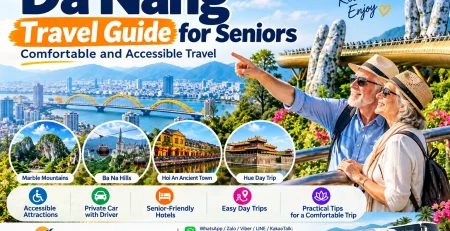
Discover Vietnam’s best destinations for senior travelers with comfortable private transportation, relaxing itineraries and essential travel tips from Danang Transfer.
Whether you are traveling as a retired couple, organizing a family vacation with elderly parents, or planning a multigenerational trip with grandparents, this comprehensive Vietnam Travel Guide for Senior Travelers will help you create a comfortable, enjoyable, and unforgettable holiday.
In this guide, you will discover:
-
The best destinations in Vietnam for senior travelers.
-
The most suitable time of year to visit each region.
-
Senior-friendly attractions with minimal walking.
-
Comfortable seven-day, ten-day, and fourteen-day itinerary options.
-
How to choose suitable hotels and private transportation.
-
Practical advice for travelers with reduced mobility.
-
Estimated travel costs and ways to avoid unnecessary expenses.
-
Health, safety, visa, and travel insurance considerations.
-
How to organize a customized Vietnam private tour with a professional driver.
For a broader introduction to the country, explore our Complete Vietnam Travel Guide and Vietnam Travel Guide 2026
MENU
- 1. 1. Why Vietnam Is an Excellent Destination for Senior Travelers
- 2. 2. What Senior Travelers Should Consider Before Visiting Vietnam
- 3. 3. Best Places to Visit in Vietnam for Senior Travelers
- 3.1. 3.1. Hanoi: Discover Vietnam’s Cultural and Historical Heritage
- 3.2. 3.2. Ninh Binh: Peaceful Countryside and Spectacular Limestone Landscapes
- 3.3. 3.3. Ha Long Bay: Relaxing Cruises and Magnificent Ocean Scenery
- 3.4. 3.4. Da Nang: A Convenient Base for Relaxing Central Vietnam Holidays
- 3.5. 3.5. Hoi An: Lantern-Lit Streets, Traditional Culture and Riverside Dining
- 3.6. 3.6. Hue: Imperial History, Traditional Architecture and Scenic Drives
- 3.7. 3.7. Nha Trang: Beach Resorts, Coastal Scenery and Wellness Experiences
- 3.8. 3.8. Ho Chi Minh City: History, Modern Comfort and Southern Vietnamese Culture
- 4. 4. Best Time to Visit Vietnam for Senior Travelers
- 5. 5. The Best 7-Day Vietnam Itinerary for Senior Travelers
- 5.1. Day 1: Arrival in Da Nang and a Relaxing Afternoon
- 5.2. Day 2: Discover Da Nang at a Comfortable Pace
- 5.3. Day 3: Ba Na Hills and the Golden Bridge
- 5.4. Day 4: Relaxing Afternoon and Evening in Hoi An
- 5.5. Day 5: Hue Imperial City and Hai Van Pass
- 5.6. Day 6: A Full Day of Relaxation
- 5.7. Day 7: Departure from Da Nang
- 6. 6. Recommended 10-Day Vietnam Itinerary for Seniors
- 7. 7. Recommended 14-Day Vietnam Itinerary for Senior Travelers
- 8. 8. Choosing the Right Hotels for Senior Travelers in Vietnam
- 9. 9. Private Transportation in Vietnam: A Comfortable Choice for Seniors
- 10. 10. How Much Does a Senior-Friendly Vietnam Vacation Cost?
- 11. 11. Health and Safety Tips for Senior Travelers in Vietnam
- 12. 12. Traveling in Vietnam with Limited Mobility or a Wheelchair
- 13. 13. Vietnamese Food for Senior Travelers: What to Eat and Where
- 14. 14. Essential Vietnam Travel Information for Seniors
- 15. 15. Vietnam Travel for Seniors: Frequently Asked Questions
- 15.1. Is Vietnam suitable for travelers over 60 or 70?
- 15.2. Is Vietnam suitable for travelers over 80?
- 15.3. What is the most convenient destination in Vietnam for seniors?
- 15.4. How many days should seniors spend in Vietnam?
- 15.5. Can seniors visit Ba Na Hills and the Golden Bridge?
- 15.6. Is Hoi An suitable for elderly travelers?
- 15.7. Is it better to travel independently or book a private tour?
- 15.8. Are private drivers available throughout Vietnam?
- 15.9. Can I book a private car for several days?
- 15.10. Can seniors travel to Vietnam on a cruise?
- 16. 16. Why Choose Danang Transfer for Your Vietnam Senior Travel Experience?
- 17. 17. Plan Your Senior-Friendly Vietnam Vacation with Danang Transfer
1. Why Vietnam Is an Excellent Destination for Senior Travelers
Vietnam has become an increasingly attractive destination for international visitors seeking a combination of cultural discovery, natural beauty, relaxation, and good value for money.

Discover why Vietnam is an excellent destination for senior travelers, with breathtaking scenery, rich culture, comfortable hotels and convenient private transportation.
For senior travelers, one of Vietnam’s greatest advantages is the variety of experiences available within relatively short distances, particularly in Central Vietnam.
You can spend the morning exploring a historical landmark, enjoy lunch overlooking the ocean, relax at your hotel during the hottest part of the afternoon, and finish the day with a peaceful riverside dinner.
With the right itinerary, there is no need to rush between attractions or participate in physically demanding activities.
1.1. Comfortable accommodation for different budgets
Vietnam offers an extensive range of hotels and resorts, from affordable boutique properties to luxurious international beachfront resorts.
Popular destinations such as Hanoi, Da Nang, Hoi An, Hue, Nha Trang, and Ho Chi Minh City have many modern hotels offering elevators, air-conditioned rooms, restaurants, swimming pools, and professional hospitality services.
For travelers over 60 or 70, staying in a centrally located hotel with suitable facilities can make sightseeing significantly easier.
A comfortable hotel also provides a convenient place to rest between morning and evening activities.
1.2. Excellent opportunities for cultural sightseeing
Vietnam has a rich cultural heritage shaped by thousands of years of history.
Older travelers interested in history, architecture, religion, and traditional lifestyles can enjoy visiting imperial palaces, ancient towns, historical museums, temples, pagodas, and traditional villages.
Many cultural attractions can be incorporated into a relaxed itinerary with regular breaks.
For example, a trip to Hue can focus on selected areas of the Imperial City rather than attempting to explore the entire complex in one afternoon.
Similarly, visitors to Hoi An can enjoy its historic architecture and lantern-lit riverside without spending several hours walking through crowded streets.
1.3. Beautiful landscapes without strenuous hiking
Vietnam is famous for its mountains, rivers, beaches, rice fields, and spectacular coastal scenery.
Fortunately, many of these landscapes can be appreciated without strenuous physical activity.
Senior-friendly experiences include scenic drives along Hai Van Pass, peaceful countryside excursions, boat trips through Ninh Binh, comfortable cruises in Ha Long Bay, and relaxing beach holidays in Da Nang or Nha Trang.
The important consideration is choosing activities that match your mobility, energy levels, and personal interests.
1.4. Affordable private transportation
One of the biggest advantages of traveling in Vietnam is the availability of private transportation at relatively affordable prices.
Instead of navigating public buses or arranging multiple taxis, visitors can hire a private car with a professional driver for airport transfers, sightseeing, and longer journeys between cities.
A private vehicle provides door-to-door convenience, air conditioning, luggage storage, and flexible departure times.
For elderly travelers, these benefits can make a considerable difference to the overall travel experience.
Learn more in our Vietnam Car Rental with Driver Guide and Private Driver Vietnam Guide
2. What Senior Travelers Should Consider Before Visiting Vietnam
A successful senior-friendly vacation begins long before arriving at the airport.
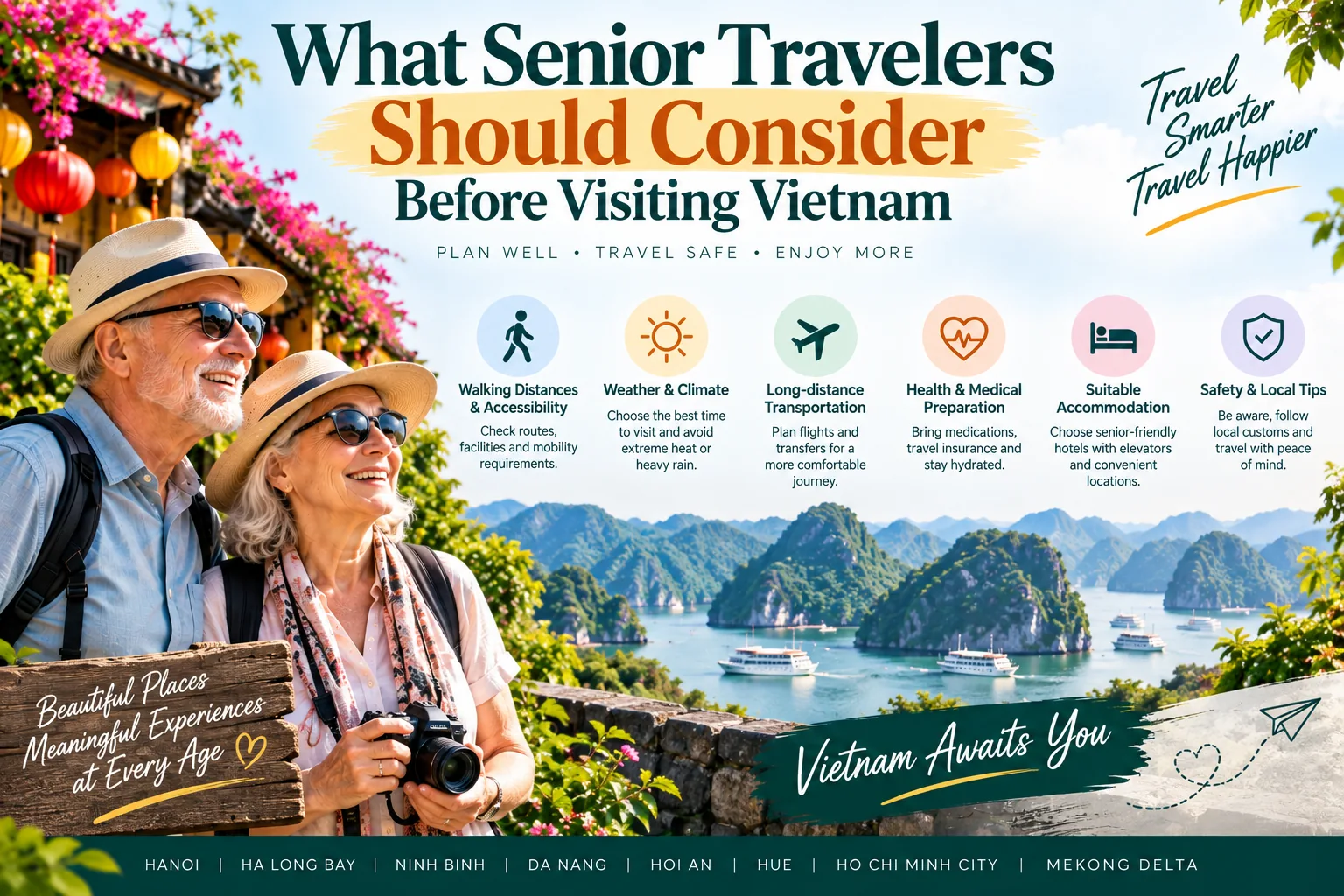
Essential Vietnam travel tips for seniors, including accessible attractions, comfortable private transportation, suitable accommodation and health precautions.
Although Vietnam is suitable for many older travelers, certain aspects of the country require additional planning.
2.1. Walking distances and accessibility
Accessibility varies considerably between Vietnamese cities, hotels, and tourist attractions.
Modern shopping centers, international hotels, and newer resorts may provide elevators, ramps, and accessible restrooms.
However, historical attractions often have uneven surfaces, steps, narrow entrances, and long walking routes.
Popular destinations such as Hoi An Ancient Town, Hue Imperial City, and Ba Na Hills can involve more walking than visitors initially expect.
Travelers with reduced mobility should check the accessibility of each attraction rather than relying solely on descriptions such as “easy sightseeing” or “suitable for seniors.”
2.2. Tropical weather and humidity
Vietnam’s climate varies significantly between Northern, Central, and Southern Vietnam.
Summer temperatures and high humidity can make outdoor sightseeing uncomfortable, particularly for travelers who are not accustomed to tropical weather.
Whenever possible, schedule outdoor attractions early in the morning or later in the afternoon.
Use the middle of the day for lunch, hotel relaxation, indoor attractions, or air-conditioned transportation.
2.3. Long-distance transportation
Vietnam is a geographically long country.
Traveling between Hanoi, Da Nang, and Ho Chi Minh City involves considerable distances.
Trying to visit too many cities in a short vacation can result in frequent airport transfers, long journeys, and repeated hotel check-ins.
For most senior travelers, spending at least two or three nights in each destination is preferable to changing hotels every day.
2.4. Individual mobility and medical requirements
Age alone does not determine what activities someone can enjoy.
Some travelers in their seventies or eighties are comfortable walking several kilometers, while others may require shorter routes, mobility assistance, or step-free access.
Before booking a tour, consider your group’s individual requirements.
Discuss walking tolerance, stairs, vehicle boarding, dietary restrictions, medication schedules, and any mobility equipment that needs to be transported.
If a traveler uses a wheelchair, confirm whether the vehicle is genuinely wheelchair accessible. A standard passenger van with luggage space is not necessarily suitable for transporting someone who must remain seated in a wheelchair.
3. Best Places to Visit in Vietnam for Senior Travelers
Choosing the right destinations is one of the most important parts of planning a comfortable Vietnam vacation.
Rather than focusing exclusively on famous attractions, consider travel distances, climate, hotel availability, and the amount of walking required.
The following destinations offer a combination of cultural experiences, beautiful scenery, and opportunities for relaxation.
3.1. Hanoi: Discover Vietnam’s Cultural and Historical Heritage
Hanoi is an excellent starting point for travelers interested in Vietnam’s history, architecture, and traditional culture.

The capital is known for its tree-lined boulevards, historic buildings, traditional markets, lakes, museums, and distinctive cuisine.
Although Hanoi can be busy, a carefully planned itinerary allows older visitors to enjoy its highlights without spending excessive time walking through crowded streets.
Recommended senior-friendly activities in Hanoi
Hoan Kiem Lake
Hoan Kiem Lake is one of Hanoi’s most recognizable landmarks.
The surrounding area offers attractive views, cafés, historical architecture, and opportunities to observe everyday local life.
Travelers who prefer limited walking can enjoy the lake from a nearby café rather than completing the entire walking circuit.
Temple of Literature
The Temple of Literature is an important historical and cultural landmark.
Visitors can explore its traditional architecture, courtyards, and gardens.
Some sections contain steps and uneven surfaces, so travelers with mobility limitations should plan their route carefully.
Traditional water puppet show
A water puppet performance is an enjoyable cultural experience that requires relatively little physical activity.
The performances introduce visitors to traditional Vietnamese music, folklore, and rural life.
Reserve seats in advance and confirm access arrangements if necessary.
Hanoi Old Quarter
The Old Quarter is famous for its narrow streets, traditional shops, and local food.
However, crowded pavements and busy traffic can make extensive walking challenging.
A short guided visit combined with a traditional cyclo experience, where suitable, can provide an alternative to a long walking tour.
Recommended stay: Two to three nights.
Accommodation advice: Choose a comfortable hotel near Hoan Kiem Lake or in a convenient central location with good vehicle access.
For more inspiration, read our Northern Vietnam Travel Guide .
For private transportation, explore our Hanoi Private Car Services and Noi Bai Airport Transfers .
3.2. Ninh Binh: Peaceful Countryside and Spectacular Limestone Landscapes
Ninh Binh is an appealing destination for travelers who appreciate natural scenery and peaceful countryside.

Located approximately two hours south of Hanoi by road, it is famous for dramatic limestone mountains, winding rivers, traditional villages, and beautiful rice fields.
Unlike busy urban destinations, Ninh Binh offers opportunities to slow down and enjoy Vietnam’s rural landscapes.
Recommended activities
Trang An Scenic Landscape Complex
Trang An is one of Ninh Binh’s most famous attractions.
Visitors travel by traditional rowing boat through beautiful waterways surrounded by limestone mountains and natural caves.
The scenery is spectacular, and the experience requires relatively little walking once aboard.
However, excursions can last several hours. Boat boarding, low cave ceilings, and prolonged sitting may be uncomfortable for some travelers.
Check the route and duration before purchasing tickets.
Tam Coc
Tam Coc offers another scenic boat experience through rivers and limestone landscapes.
It can be particularly beautiful when the surrounding rice fields are green or golden.
Choose between Trang An and Tam Coc rather than attempting to visit both on the same day.
Hoa Lu Ancient Capital
Hoa Lu provides an opportunity to discover Vietnam’s early imperial history.
The historical complex contains temples and traditional architecture surrounded by beautiful mountain scenery.
Some areas have steps and uneven surfaces, so choose the sightseeing route according to your mobility.
Recommended stay: One or two nights.
A day trip from Hanoi is possible, but staying overnight allows visitors to explore the countryside without rushing.
3.3. Ha Long Bay: Relaxing Cruises and Magnificent Ocean Scenery
Ha Long Bay is one of Vietnam’s most celebrated natural attractions.

Its dramatic limestone islands, emerald waters, and beautiful coastal landscapes make it particularly attractive for travelers who enjoy scenic cruises.
For senior visitors, an overnight cruise can provide a comfortable way to experience the bay without frequent hotel changes or extensive sightseeing on foot.
Recommended activities
-
Enjoying panoramic views from the cruise deck.
-
Relaxing in a comfortable cabin.
-
Watching the sunset over the limestone islands.
-
Enjoying Vietnamese cuisine on board.
-
Participating in optional sightseeing activities according to individual mobility.
When choosing a cruise, pay particular attention to accessibility.
Many vessels have narrow staircases, high boarding steps, and cabins that can only be reached by stairs.
Not all cruises offer elevators or wheelchair-accessible accommodation.
Travelers with limited mobility should contact the cruise operator directly and confirm boarding arrangements, cabin locations, bathroom accessibility, and emergency procedures.
A two-day, one-night cruise is often sufficient for travelers who want to experience the scenery without spending too much time away from Hanoi.
3.4. Da Nang: A Convenient Base for Relaxing Central Vietnam Holidays
Da Nang is particularly convenient for senior travelers who want to combine beach relaxation with cultural sightseeing.
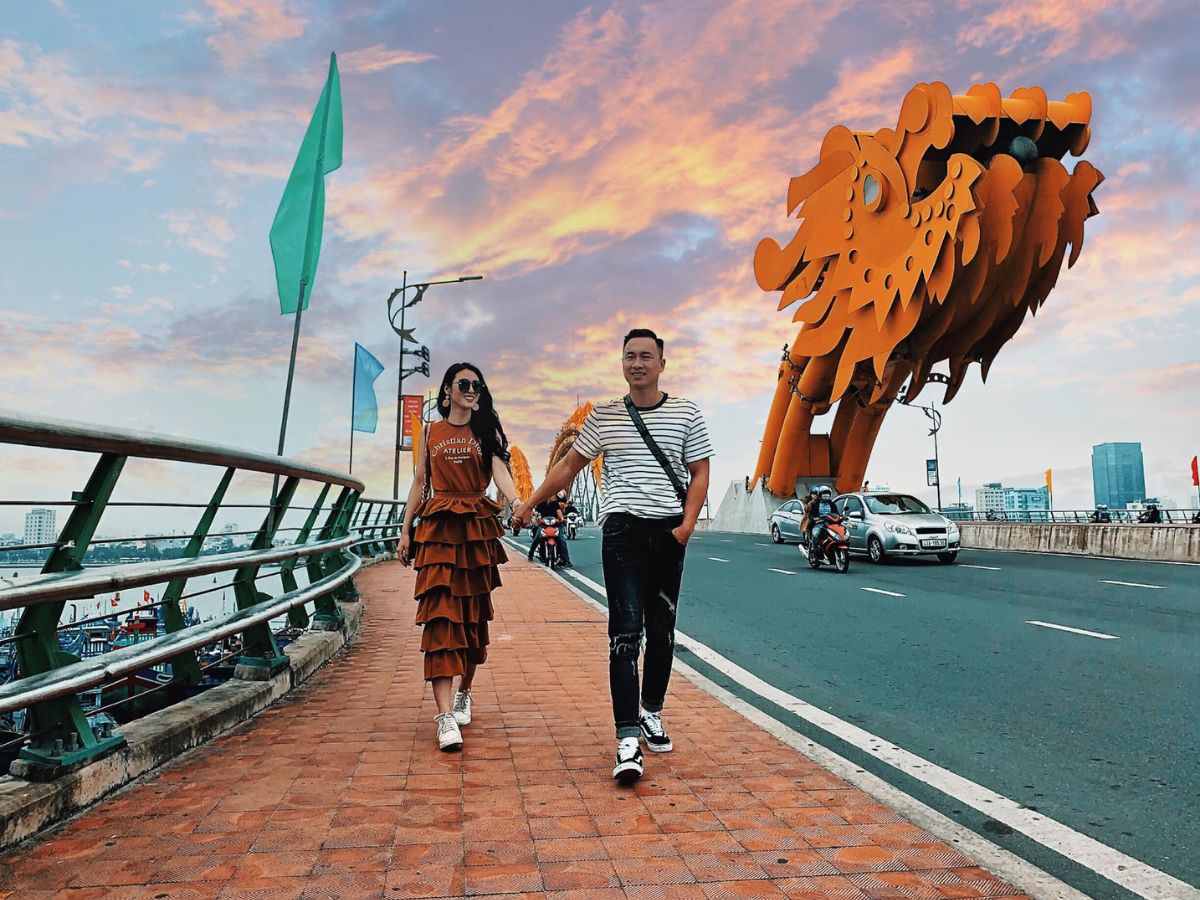
The city offers modern hotels, international beachfront resorts, restaurants, shopping centers, and relatively easy access to some of Central Vietnam’s most famous attractions.
It is also an excellent base for exploring Hoi An, Hue, Ba Na Hills, and the Hai Van Pass.
Staying in Da Nang for several nights allows visitors to enjoy different destinations without constantly changing hotels.
Recommended activities
My Khe Beach
My Khe Beach is known for its long coastline, beautiful ocean views, and nearby beachfront hotels.
Travelers can enjoy a leisurely morning walk, relax at a beachfront café, or simply admire the scenery from their hotel.
Linh Ung Pagoda
Located on the Son Tra Peninsula, Linh Ung Pagoda is famous for its impressive Lady Buddha statue and panoramic coastal views.
Private vehicles can reach the main visitor area, although exploring the grounds involves some walking.
Dragon Bridge and Han River
The Dragon Bridge and Han River waterfront are popular evening attractions.
Visitors can enjoy the illuminated bridges, riverside restaurants, and city views.
A short evening drive is an alternative for travelers who prefer not to walk along the waterfront.
Son Tra Peninsula
A scenic drive around accessible areas of the Son Tra Peninsula offers beautiful ocean views and opportunities for photography.
Road access can change because of weather, traffic restrictions, and vehicle limitations.
Recommended stay: Three to five nights.
For visitors who prefer a relaxing beach holiday combined with occasional sightseeing, staying longer is also an excellent option.
Explore our Da Nang Travel Guide , 10 Things to Do in Da Nang , and Da Nang Private Car Services .
3.5. Hoi An: Lantern-Lit Streets, Traditional Culture and Riverside Dining
Hoi An is one of Vietnam’s most charming destinations.

Its Ancient Town is famous for traditional architecture, colorful lanterns, historic merchant houses, and peaceful riverside scenery.
For senior travelers, Hoi An offers a wonderful combination of cultural discovery, traditional cuisine, boutique accommodation, and relaxing activities.
However, visitors should be aware that large parts of the Ancient Town have restricted vehicle access.
Recommended activities
Hoi An Ancient Town
Explore selected historical streets, traditional buildings, and cultural landmarks.
Instead of attempting to see every attraction, choose two or three locations within a relatively small area.
Take regular breaks at local cafés.
Japanese Covered Bridge
The Japanese Covered Bridge is one of Hoi An’s most recognizable historical landmarks.
It can be incorporated into a short sightseeing route through the Ancient Town.
Lantern-lit riverside
Hoi An becomes especially atmospheric after sunset when colorful lanterns illuminate the streets and river.
An early dinner followed by a short evening visit is an enjoyable option for older travelers.
Traditional cooking experiences
A Vietnamese cooking class can provide an opportunity to discover local cuisine and traditional ingredients.
Choose a class with comfortable seating, suitable kitchen facilities, and minimal walking.
An Bang Beach
For travelers who prefer a quieter atmosphere, An Bang Beach offers beachfront restaurants, cafés, and relaxing ocean views.
Recommended stay: Two to three nights, or visit Hoi An as a day trip from Da Nang.
For more information, read our Hoi An Travel Guide for First-Time Visitors and explore our Hoi An Private Car Services .
3.6. Hue: Imperial History, Traditional Architecture and Scenic Drives
Hue is an essential destination for travelers interested in Vietnam’s royal history and cultural heritage.
The former imperial capital is known for its historical monuments, traditional architecture, royal tombs, and beautiful riverside setting.

A carefully planned Hue excursion can be an enjoyable experience for seniors, particularly when combined with private transportation.
Recommended activities
Hue Imperial City
The Imperial City is one of Vietnam’s most important historical attractions.
Because the complex is extensive, visitors should focus on selected landmarks rather than attempting to explore the entire site.
Some sections have uneven surfaces, stairs, and long distances between attractions.
Thien Mu Pagoda
Located beside the Perfume River, Thien Mu Pagoda is famous for its historic seven-story tower.
The riverside setting makes it an attractive destination for photography and cultural sightseeing.
Royal tombs
Hue’s royal tombs provide fascinating insights into the Nguyen Dynasty.
Choose one tomb according to your interests and mobility rather than visiting several in quick succession.
Hai Van Pass and Lang Co
Traveling between Da Nang and Hue offers an opportunity to enjoy some of Central Vietnam’s most beautiful coastal scenery.
A scenic drive through Hai Van Pass, Lang Co, and Lap An Lagoon can be an enjoyable experience in its own right.
Recommended stay: One or two nights.
For travelers who want to avoid a long return journey, staying overnight in Hue is preferable to combining extensive sightseeing with a same-day return to Da Nang.
Explore our Central Vietnam Travel Guide and Hue Private Car Services .
3.7. Nha Trang: Beach Resorts, Coastal Scenery and Wellness Experiences
Nha Trang is a popular destination for travelers seeking a relaxing coastal vacation.
Its beautiful beaches, beachfront hotels, seafood restaurants, and resort facilities make it attractive for older couples and families.
Visitors can enjoy several days of relaxation without following a demanding sightseeing schedule.
Recommended activities
-
Relaxing at beachfront resorts.
-
Enjoying coastal drives.
-
Visiting selected cultural attractions.
-
Experiencing suitable spa and wellness treatments.
-
Enjoying seafood restaurants with ocean views.
Travelers considering island excursions should check weather conditions, boat boarding arrangements, and the physical requirements of each activity.
Recommended stay: Three to four nights.
Discover our Nha Trang Private Car Services and Cam Ranh Airport Transfers .
3.8. Ho Chi Minh City: History, Modern Comfort and Southern Vietnamese Culture
Ho Chi Minh City offers a fascinating combination of modern urban life and historical attractions.
The city is particularly suitable for travelers interested in museums, colonial-era architecture, traditional markets, and Vietnamese cuisine.
Because traffic can be heavy, choosing a centrally located hotel and arranging private transportation is advisable.
Recommended activities
Central Post Office
The historic Central Post Office is one of the city’s most recognizable architectural landmarks.
War Remnants Museum
The museum offers important historical perspectives on the Vietnam War. Some exhibits contain distressing material, so visitors should consider their personal preferences.
Reunification Palace
This historical landmark provides insight into modern Vietnamese history.
Visitors should check accessibility arrangements before planning an extensive tour of the building.
Saigon River dinner cruise
A dinner cruise offers an opportunity to enjoy the city skyline and evening atmosphere.
Confirm boarding accessibility and vessel facilities before booking.
Recommended stay: Two to three nights.
Explore our Ho Chi Minh City Private Car Services and Tan Son Nhat Airport Transfers .
4. Best Time to Visit Vietnam for Senior Travelers
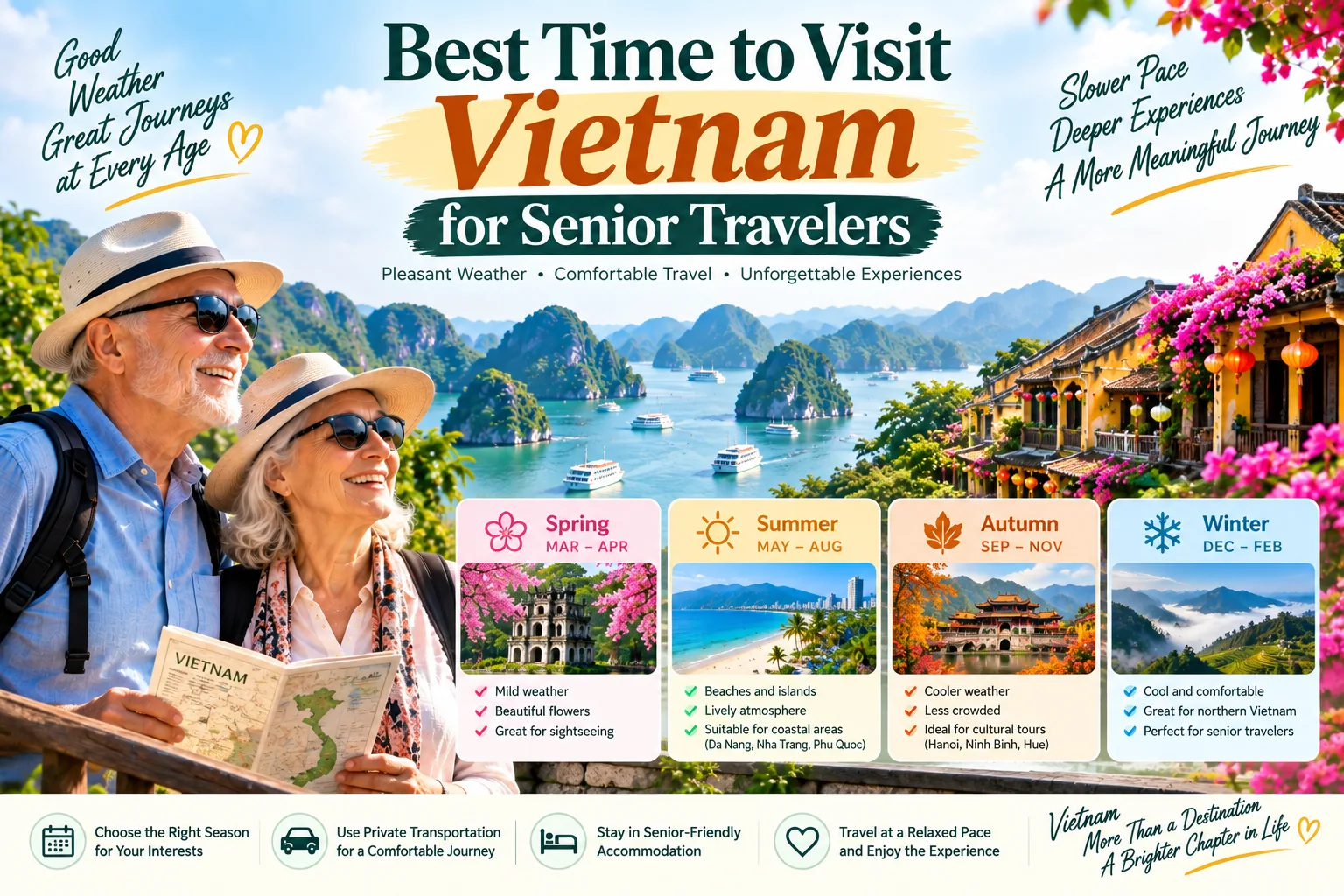
Discover the best time to visit Vietnam for seniors, with seasonal weather tips, comfortable sightseeing and recommended destinations throughout the year.
Weather is one of the most important considerations when planning a senior-friendly vacation in Vietnam.
The country has three main geographical regions, each with different seasonal weather patterns. While one destination may enjoy pleasant sunshine, another may experience heavy rainfall or uncomfortable humidity.
For older travelers, choosing the right season can make outdoor sightseeing significantly more enjoyable.
4.1. Northern Vietnam: Hanoi, Ninh Binh and Ha Long Bay
March to April and October to November are generally favorable periods for exploring Northern Vietnam.
During these months, temperatures are often more comfortable for outdoor sightseeing than during the peak summer season.
Spring is particularly attractive for visiting Hanoi’s historical attractions and enjoying the countryside around Ninh Binh.
Autumn is another popular period, offering opportunities for scenic excursions and comfortable city sightseeing.
From May to September, Northern Vietnam can experience high temperatures, humidity, and heavy rainfall.
Winter, particularly December through February, can be surprisingly cool. Travelers visiting mountainous destinations such as Sapa should prepare for colder conditions.
4.2. Central Vietnam: Da Nang, Hoi An and Hue
February to April is generally an attractive period for senior travelers visiting Central Vietnam.
Temperatures are often more comfortable for sightseeing, and conditions can be suitable for combining cultural attractions with beach relaxation.
May to August can bring hot weather, making early morning sightseeing and afternoon hotel breaks especially important.
September to December is generally associated with increased rainfall in parts of Central Vietnam.
Heavy rain, flooding, and tropical storms can occasionally disrupt sightseeing and transportation, particularly around Hoi An and Hue.
Travelers visiting during the rainy season should maintain flexible schedules and consider refundable accommodation where available.
4.3. Southern Vietnam: Ho Chi Minh City and the Mekong Delta
Southern Vietnam has a tropical climate with relatively consistent temperatures throughout the year.
December to April generally corresponds to the drier season and is often more convenient for outdoor sightseeing.
May to November is typically wetter, although rainfall frequently occurs in afternoon showers rather than continuing throughout the entire day.
For seniors visiting Ho Chi Minh City, air-conditioned transportation and carefully scheduled sightseeing remain useful throughout the year.
Travel tip: If you are particularly sensitive to heat, avoid organizing several consecutive outdoor activities during the hottest part of the day.
For detailed regional weather information, read our Best Time to Visit Vietnam: Weather by Month and Region .
5. The Best 7-Day Vietnam Itinerary for Senior Travelers
For visitors who prefer a relaxed vacation without frequent domestic flights, a seven-day itinerary based in Central Vietnam is an attractive option.
Da Nang provides convenient access to beautiful beaches, historical attractions, traditional villages, mountain scenery, and cultural experiences.
The following itinerary is designed for older couples, retired travelers, and families traveling with elderly parents.
It includes flexible sightseeing periods, comfortable private transportation, and sufficient time for relaxation.
Day 1: Arrival in Da Nang and a Relaxing Afternoon
Recommended schedule
|
Time |
Activity |
|---|---|
|
09:00 |
Airport pickup |
|
10:00 |
Hotel arrival and luggage drop-off |
|
12:00 |
Lunch near the hotel |
|
13:00–16:00 |
Hotel check-in and relaxation |
|
17:00 |
Optional visit to My Khe Beach |
|
18:30 |
Dinner |
|
20:00 |
Return to hotel |
After arriving at Da Nang International Airport, meet your private driver and travel directly to your hotel.
Avoid scheduling major sightseeing activities immediately after a long international flight.
Instead, spend the first day adjusting to the local climate, enjoying a comfortable meal, and relaxing at your accommodation.
If you arrive early in the morning, consider arranging early check-in or booking the previous night to guarantee immediate room access.
In the late afternoon, take a short trip to My Khe Beach or enjoy dinner at a nearby restaurant.
Walking requirements: Minimal. Optional beach or waterfront walking.
Recommended accommodation: A beachfront hotel in Da Nang with elevators, spacious rooms, and convenient restaurant access.
Day 2: Discover Da Nang at a Comfortable Pace
Begin the day with a leisurely breakfast before meeting your private driver.
The first destination is Linh Ung Pagoda on the Son Tra Peninsula.
Enjoy panoramic views of the coastline and admire the impressive Lady Buddha statue.
Rather than spending too much time walking around the temple grounds, choose a comfortable sightseeing route and allow time for photography.
Continue with a scenic coastal drive before stopping for lunch.
After lunch, return to your hotel for an afternoon rest.
In the early evening, explore the Han River area and enjoy dinner overlooking the illuminated city.
Suggested itinerary: Hotel → Linh Ung Pagoda → Scenic coastal drive → Lunch → Hotel rest → Dragon Bridge → Dinner → Hotel.
Walking requirements: Approximately 30–60 minutes in short intervals, depending on your preferences.
Important: Visitors with reduced mobility should confirm vehicle drop-off arrangements and accessibility at Linh Ung Pagoda.
Day 3: Ba Na Hills and the Golden Bridge
Ba Na Hills is one of Central Vietnam’s most famous tourist attractions.
Located in the mountains west of Da Nang, it offers spectacular scenery, an extensive cable car system, the famous Golden Bridge, and European-inspired architecture.
For senior travelers, an early departure is generally preferable because it allows more time for sightseeing before the busiest periods.
Suggested schedule
|
Time |
Activity |
|---|---|
|
07:30 |
Depart from Da Nang |
|
08:30 |
Arrive at Ba Na Hills |
|
09:00 |
Cable car journey |
|
09:30 |
Golden Bridge sightseeing |
|
11:30 |
Lunch |
|
13:00 |
Optional French Village visit |
|
14:30 |
Cable car descent |
|
16:00 |
Return to hotel |
Although the cable car provides convenient mountain access, Ba Na Hills is not entirely accessible without walking.
The Golden Bridge, cable car stations, and French Village can involve considerable distances, stairs, slopes, and queues.
Travelers who cannot walk comfortably for extended periods should consider limiting the visit to selected attractions.
A shorter itinerary focused on the Golden Bridge may be more enjoyable than attempting to explore the entire complex.
Walking requirements: Moderate, with some potentially challenging sections.
Alternative: Replace Ba Na Hills with a relaxing spa day or shorter coastal excursion if anyone in your group has significant mobility limitations.
Day 4: Relaxing Afternoon and Evening in Hoi An
Spend the morning relaxing at your hotel.
After lunch, travel to Hoi An by private car.
Arriving in the late afternoon allows you to avoid some of the midday heat while enjoying the Ancient Town’s distinctive atmosphere.
Begin with a short sightseeing visit to selected historical streets and traditional buildings.
Stop at a comfortable café before enjoying an early dinner.
After sunset, admire Hoi An’s colorful lanterns and riverside scenery.
Travelers who are comfortable boarding small boats may enjoy an optional lantern boat experience.
Suggested itinerary: Da Nang → Hoi An Ancient Town → Café → Early dinner → Lantern viewing → Da Nang.
Walking requirements: Approximately 30–60 minutes, divided into shorter periods.
Important: Private cars cannot enter many pedestrian areas of Hoi An Ancient Town. Your driver will arrange a suitable meeting point outside the restricted area.
Day 5: Hue Imperial City and Hai Van Pass
A scenic excursion to Hue offers an opportunity to experience Central Vietnam’s beautiful coastline and imperial heritage.
Depart from Da Nang in the morning and travel north through the spectacular Hai Van Pass.
Stop at suitable viewpoints before continuing toward Lang Co Beach and Lap An Lagoon.
Enjoy lunch in Hue before visiting selected sections of the Imperial City.
For seniors, it is generally better to explore one or two important historical attractions rather than attempting to visit every royal tomb and pagoda in a single day.
Return to Da Nang in the late afternoon.
Suggested itinerary: Da Nang → Hai Van Pass → Lang Co → Lap An Lagoon → Hue → Imperial City → Da Nang.
Driving time: Approximately four to six hours in total, depending on the route, traffic, and sightseeing stops.
Walking requirements: Light to moderate, depending on the selected attractions.
Alternative: Stay overnight in Hue to reduce the amount of driving and allow more time for sightseeing.
Day 6: A Full Day of Relaxation
After several days of sightseeing, dedicate one day entirely to rest and relaxation.
Spend the morning enjoying your hotel’s facilities.
Consider a gentle spa treatment, a leisurely lunch, or a short shopping excursion.
If you would like another cultural experience, arrange a traditional Vietnamese cooking class or a short visit to a local market.
Avoid scheduling activities simply to fill every available hour.
A relaxing day can make the entire vacation more enjoyable, especially for older travelers who prefer a slower pace.
Day 7: Departure from Da Nang
Enjoy breakfast at your hotel before your private airport transfer.
Arrange your pickup time according to your flight schedule, airline recommendations, and airport check-in requirements.
For international departures, allowing approximately three hours before the flight is a common planning guideline, although your airline’s instructions should take priority.
Your driver will collect you from the hotel and transport you directly to Da Nang International Airport.
For other itinerary ideas, explore our Vietnam 7-Day Itinerary and How to Plan a 7-Day Trip in Vietnam .
6. Recommended 10-Day Vietnam Itinerary for Seniors
If you have ten days available, you can enjoy a more varied Vietnam vacation while maintaining a comfortable travel schedule.
A practical approach is to combine Northern and Central Vietnam, using one domestic flight to avoid an excessively long overland journey.
The following itinerary includes Hanoi, Ninh Binh, Da Nang, Hoi An, and Hue.
|
Day |
Destination |
Suggested activities |
|---|---|---|
|
1 |
Hanoi |
Airport arrival, hotel check-in and relaxation |
|
2 |
Hanoi |
Hoan Kiem Lake, Temple of Literature and water puppet show |
|
3 |
Ninh Binh |
Scenic countryside excursion and Trang An boat trip |
|
4 |
Hanoi → Da Nang |
Domestic flight, beachfront hotel and rest |
|
5 |
Da Nang |
Linh Ung Pagoda, coastal sightseeing and Han River |
|
6 |
Ba Na Hills |
Optional Golden Bridge visit or resort relaxation |
|
7 |
Hoi An |
Afternoon sightseeing and evening lantern experience |
|
8 |
Hue |
Scenic drive via Hai Van Pass and selected historical attractions |
|
9 |
Da Nang |
Free day, shopping, spa or beach relaxation |
|
10 |
Departure |
Private airport transfer |
This itinerary is designed to minimize hotel changes.
You can spend the first three nights in Hanoi and the remaining six nights in Da Nang.
A private day trip to Ninh Binh eliminates the need to change hotels, while a domestic flight between Hanoi and Da Nang saves considerable travel time.
However, travelers who prefer shorter sightseeing days may find the Ninh Binh and Hue excursions tiring.
Both destinations can be adapted into overnight visits or replaced with additional relaxation days.
For more inspiration, read our Vietnam 10-Day Itinerary for First-Time Visitors .
7. Recommended 14-Day Vietnam Itinerary for Senior Travelers
A two-week vacation provides an opportunity to discover Northern, Central, and Southern Vietnam without following an excessively demanding schedule.
The key is to limit unnecessary hotel changes and use domestic flights for longer journeys.
Days 1–3: Hanoi
Spend three nights exploring Hanoi’s historical landmarks, traditional cuisine, cultural performances, and beautiful lakes.
Include a free afternoon after your arrival and avoid scheduling too many attractions on the same day.
Days 4–5: Ninh Binh or Ha Long Bay
Choose between a relaxing countryside stay in Ninh Binh and a comfortable overnight cruise in Ha Long Bay.
Both destinations offer beautiful scenery, but their accessibility requirements differ.
For travelers with mobility limitations, carefully review the facilities of any boat or cruise vessel before booking.
Day 6: Travel to Da Nang
Return to Hanoi and take a domestic flight to Da Nang.
Arrange a private airport transfer and spend the remainder of the day relaxing at your beachfront hotel.
Days 7–10: Da Nang and Hoi An
Use Da Nang as your base for comfortable sightseeing.
Explore the coastline, visit Linh Ung Pagoda, enjoy an afternoon in Hoi An, and consider a visit to Ba Na Hills.
Include at least one full day without scheduled sightseeing.
Day 11: Hue
Enjoy a scenic transfer to Hue via Hai Van Pass.
Stay overnight to avoid spending too much time in the vehicle.
Day 12: Hue to Ho Chi Minh City
Transfer to Phu Bai Airport for your domestic flight to Ho Chi Minh City.
Arrange private transportation to your hotel and enjoy a relaxing evening.
Day 13: Ho Chi Minh City
Explore selected historical landmarks, enjoy traditional Southern Vietnamese cuisine, and consider an optional evening river cruise.
Day 14: Departure
Enjoy breakfast before your private airport transfer.
This itinerary combines several of Vietnam’s most interesting regions while maintaining sufficient time for relaxation.
For travelers who prefer fewer domestic flights, consider spending the entire two weeks in Northern and Central Vietnam instead.
8. Choosing the Right Hotels for Senior Travelers in Vietnam

Discover how to choose senior-friendly hotels in Vietnam with comfortable rooms, elevators, accessible facilities, convenient locations and helpful hotel services
Accommodation plays an important role in determining how comfortable your vacation will be.
For senior travelers, hotel location, room layout, accessibility, and available facilities are often more important than decorative luxury.
A beautiful resort with numerous staircases may be less convenient than a centrally located hotel with elevators and easy vehicle access.
8.1. Choose hotels with elevators
Always confirm that your hotel has elevators serving the floors where your rooms are located.
Some boutique hotels in historical buildings have limited elevator access or require guests to climb stairs to reach certain rooms.
If stairs are difficult for anyone in your group, request a suitable room before making a nonrefundable reservation.
8.2. Request accessible bathrooms
Bathrooms can present challenges for travelers with limited mobility.
Consider requesting rooms with walk-in showers, nonslip flooring, grab rails, and sufficient space to move comfortably.
A hotel advertising accessible accommodation does not necessarily mean every room has these facilities.
Confirm the exact bathroom layout directly with the property.
8.3. Prioritize convenient locations
A centrally located hotel can reduce the amount of time spent traveling between restaurants, attractions, and shopping areas.
In Hanoi, accommodation near Hoan Kiem Lake is convenient for many cultural activities.
In Da Nang, beachfront hotels near My Khe Beach provide access to restaurants, coastal scenery, and major sightseeing routes.
In Hoi An, riverside accommodation outside the busiest pedestrian areas may offer a good balance between convenience and relaxation.
8.4. Consider connecting rooms or serviced apartments
For families traveling with elderly parents, connecting rooms can provide privacy while keeping everyone close together.
A spacious serviced apartment may also be suitable for longer stays.
However, check whether the property has elevators, daily housekeeping, suitable bathrooms, and convenient access to restaurants.
8.5. Avoid unnecessary hotel changes
Repeatedly packing luggage, checking out, traveling between destinations, and checking into new hotels can be tiring.
Whenever practical, use one hotel as a base for several nearby destinations.
For example, Da Nang is a convenient base for visiting Hoi An, Ba Na Hills, and selected attractions in Hue.
If your itinerary includes several distant regions, consider staying at least three nights in each major destination.
9. Private Transportation in Vietnam: A Comfortable Choice for Seniors
Transportation can significantly influence the quality of a senior-friendly vacation.

Explore Vietnam comfortably with private transportation for seniors, professional local drivers, spacious vehicles and flexible sightseeing itineraries.
Vietnam offers many ways to travel, including domestic flights, trains, buses, taxis, and private vehicles.
However, older travelers who value convenience, flexibility, and comfortable door-to-door service often choose a private car with a professional driver.
9.1. Benefits of hiring a private car with a driver
Flexible departure times
You can arrange your daily sightseeing schedule around your preferred breakfast time and energy levels.
There is no need to wake up early every morning to join a fixed group tour.
Convenient hotel pickup
Your driver can collect you directly from your hotel and transport you to your selected attractions.
This reduces the need to navigate unfamiliar public transportation systems.
Comfortable air-conditioned vehicles
Air conditioning is particularly important during Vietnam’s warmer months.
A suitable private vehicle provides a comfortable place to relax between sightseeing stops.
Flexible rest breaks
You can stop for refreshments, meals, restroom breaks, or photography whenever practical.
Convenient luggage transportation
For travelers moving between cities, a private vehicle eliminates the need to carry luggage through train stations or bus terminals.
Personalized sightseeing
Private transportation allows you to modify your itinerary according to the weather, traffic conditions, and individual preferences.
9.2. Choosing the right vehicle
Vehicle size should be selected according to the number of passengers, luggage requirements, and individual mobility.
|
Vehicle |
Recommended group size |
Typical use |
|---|---|---|
|
4-seat sedan |
1–3 passengers |
Couples and individual travelers |
|
7-seat SUV/MPV |
Up to 5 passengers with limited luggage |
Small families |
|
Ford Transit van |
Approximately 6–10 passengers with luggage |
Larger families and senior groups |
|
VIP limousine |
Depends on configuration |
Premium private transportation |
|
Minibus |
Larger groups |
Group sightseeing and transfers |
For six adults traveling with several suitcases, a Ford Transit van provides additional passenger and luggage space.
However, some older travelers may find the step into a van relatively high.
If anyone in your group has difficulty boarding vehicles, discuss your requirements before confirming the booking.
In some circumstances, two smaller vehicles may be more convenient than one large van.
9.3. Private driver versus tour guide
A private driver and a licensed tour guide perform different roles.
Your driver is responsible for transportation, route planning, and safe driving.
An English-speaking tour guide provides detailed information about historical attractions, cultural traditions, and local destinations.
Drivers may speak basic English, but they should not automatically be expected to provide professional guided tours.
For travelers who want detailed historical explanations, arranging a separate licensed guide is advisable.
Learn more in our Vietnam Chauffeur Service Guide and How to Book a Private Car in Vietnam .
10. How Much Does a Senior-Friendly Vietnam Vacation Cost?
Vietnam offers excellent value for travelers seeking comfortable accommodation, private transportation, quality dining, and personalized sightseeing.
However, the total cost of your vacation will depend on your preferred hotel category, destinations, group size, travel season, and activities.
For senior travelers, spending slightly more on convenient accommodation and comfortable transportation may help avoid unnecessary fatigue and travel complications.
10.1. Estimated daily travel budget
The following figures are approximate planning estimates per person, assuming two travelers share a hotel room.
|
Expense |
Comfortable budget |
Luxury budget |
|---|---|---|
|
Hotel accommodation |
$30–60 |
$80–180+ |
|
Meals |
$15–30 |
$35–70 |
|
Local transportation |
$15–35 |
$40–80 |
|
Sightseeing and entrance fees |
$10–30 |
$30–60 |
|
Estimated daily total |
$70–155 |
$185–390+ |
These estimates exclude international flights, travel insurance, major domestic flights, and unusually expensive activities.
Private transportation can become more economical when its cost is shared among four to six travelers.
10.2. Sample private car prices in Central Vietnam
Danang Transfer offers private transportation for airport transfers, sightseeing, and intercity journeys.
The following are indicative prices in Vietnamese dong. Confirm your exact itinerary and travel date before booking.
|
Private transportation service |
4-seat car |
7-seat car |
|---|---|---|
|
Da Nang Airport to Da Nang hotel |
200,000 VND |
200,000 VND |
|
Da Nang Airport to Hoi An |
300,000 VND |
350,000 VND |
|
Da Nang to Ba Na Hills, round trip |
700,000 VND |
850,000 VND |
|
Da Nang to Hoi An, round trip |
600,000 VND |
700,000 VND |
|
Da Nang city sightseeing |
From 750,000 VND |
From 850,000 VND |
Prices depend on the exact pickup location, sightseeing route, vehicle type, waiting time, and service duration.
Entrance tickets, meals, and licensed tour guides are generally quoted separately unless specifically included in your package.
For larger groups, request a quotation for a Ford Transit van or another suitable vehicle.
You can also compare costs using our Vietnam Private Car Prices Guide , Vietnam Car Rental Price Guide , and How Much Does Car Rental in Vietnam Cost Per Day? .
10.3. How to save money without sacrificing comfort
Traveling comfortably does not necessarily mean booking the most expensive hotels and tours.
Consider staying in one centrally located hotel rather than changing accommodation frequently.
Choose a private vehicle appropriate for your group size, combine nearby attractions into the same sightseeing day, and book domestic flights early when your travel dates are confirmed.
Avoid unnecessary activities simply because they appear in popular itineraries.
For additional suggestions, read our Tips to Save Money on Da Nang Car Rental .
11. Health and Safety Tips for Senior Travelers in Vietnam
Health and safety should be important considerations when planning any international vacation, particularly for travelers with mobility limitations or ongoing medical requirements.
The following practical recommendations can help you prepare for a more comfortable journey.
11.1. Arrange comprehensive travel insurance
Before traveling, purchase appropriate insurance covering medical treatment, hospitalization, trip cancellation, and emergency medical evacuation.
Review the policy carefully if you have pre-existing medical conditions.
Some insurance providers have age-related restrictions or additional requirements for older travelers.
Make sure your insurance covers all the activities you intend to participate in.
11.2. Bring sufficient prescription medication
Carry enough prescription medication for your entire vacation, allowing for unexpected travel delays.
Keep essential medication in your hand luggage rather than checked baggage.
Bring copies of your prescriptions and any necessary medical documentation.
Some medications are subject to special import restrictions. Check the current requirements with the relevant Vietnamese authorities before departure.
11.3. Avoid dehydration and excessive heat
Vietnam’s tropical weather can be challenging for visitors who are not accustomed to high temperatures and humidity.
Drink water regularly, wear lightweight clothing, use appropriate sun protection, and avoid spending too much time outdoors during the hottest hours.
If you have a medical condition that affects your ability to tolerate heat or requires fluid restrictions, follow your healthcare professional’s advice.
11.4. Be careful when crossing busy roads
Traffic in Hanoi and Ho Chi Minh City can be unfamiliar to first-time visitors.
Motorcycles, cars, buses, and pedestrians often share busy urban roads.
Use designated pedestrian crossings where available and allow sufficient time to cross safely.
Travelers with reduced mobility may prefer to use private transportation for journeys that would otherwise require walking along busy streets.
11.5. Choose suitable restaurants
Vietnamese cuisine is one of the highlights of visiting the country.
However, travelers with sensitive stomachs, allergies, or dietary restrictions should choose restaurants carefully.
Select establishments with good hygiene practices, drink safe water, and communicate dietary requirements clearly.
For visitors with food allergies, carrying a translated allergy card can be particularly useful.
11.6. Prepare for unexpected weather
Heavy rainfall can disrupt sightseeing, particularly during Central Vietnam’s rainy season.
Mountain attractions and boat excursions may also be affected by unfavorable weather.
Maintain a flexible itinerary and avoid scheduling essential transportation connections immediately after weather-dependent activities.
For more practical advice, read our Safety Tips in Vietnam: Common Scams and How to Avoid Them .
12. Traveling in Vietnam with Limited Mobility or a Wheelchair
Vietnam can be challenging for travelers who require fully accessible facilities.
While modern hotels and airports may offer accessible infrastructure, many historical attractions, pavements, traditional restaurants, and public transportation services have limited accessibility.
This does not mean that travelers with mobility limitations cannot enjoy Vietnam. However, advance planning is essential.
12.1. Confirm hotel accessibility before booking
Contact your hotel directly and explain your specific requirements.
Ask whether there are steps at the entrance, whether elevators serve all guest floors, and whether accessible bathrooms are available.
If you use a wheelchair, request measurements of doorways and bathroom entrances when necessary.
12.2. Arrange suitable transportation
A standard private car or passenger van may be suitable for travelers who can transfer independently from a wheelchair to a vehicle seat.
However, travelers who must remain seated in their wheelchairs during transportation require a properly equipped wheelchair-accessible vehicle.
Never assume that a large passenger van is wheelchair accessible simply because it has sufficient luggage space.
12.3. Choose attractions carefully
Some of Vietnam’s famous attractions involve stairs, steep slopes, or uneven historical surfaces.
For example, the Marble Mountains in Da Nang include caves, staircases, and elevated viewpoints.
Although an elevator provides access to part of the attraction, it does not make the entire complex wheelchair accessible.
Similarly, Hoi An Ancient Town has pedestrian areas and uneven surfaces that may be difficult for wheelchair users.
12.4. Allow additional time
Avoid itineraries that require rushing between attractions.
Allow additional time for vehicle boarding, restroom breaks, meals, and unexpected accessibility challenges.
A relaxed itinerary with fewer attractions often provides a more enjoyable experience than attempting to visit several destinations in one day.
12.5. Consider a customized private itinerary
For travelers with significant mobility requirements, a customized itinerary allows attractions to be selected according to their accessibility.
Discuss your requirements with your transportation provider before confirming the booking.
13. Vietnamese Food for Senior Travelers: What to Eat and Where
Vietnamese cuisine is one of the country’s greatest attractions.
Fresh herbs, aromatic broths, rice noodles, seafood, and regional specialties offer a wide variety of dining experiences.
For older travelers, choosing suitable restaurants and communicating dietary requirements can make exploring Vietnamese cuisine even more enjoyable.
Pho: Traditional Vietnamese noodle soup
Pho is one of Vietnam’s most famous dishes.
It typically consists of rice noodles, aromatic broth, herbs, and beef or chicken.
It is widely available throughout the country and can be a convenient option for breakfast or lunch.
Banh Mi: Vietnamese baguette sandwich
Banh mi combines a crispy baguette with a variety of fillings.
Options may include grilled meat, eggs, vegetables, and herbs.
Travelers with dietary restrictions should confirm the ingredients before ordering.
Mi Quang: A Central Vietnamese specialty
Mi Quang is a traditional noodle dish associated with Central Vietnam.
It typically contains rice noodles, herbs, a small amount of flavorful broth, and ingredients such as chicken, shrimp, or pork.
It is particularly popular in Da Nang and the surrounding region.
Cao Lau: Hoi An’s signature noodles
Cao Lau is a distinctive noodle dish associated with Hoi An.
It traditionally includes thick noodles, pork, fresh herbs, and crispy toppings.
Trying Cao Lau is an enjoyable culinary experience during a visit to Hoi An.
Bun Bo Hue: Traditional Hue noodle soup
Bun Bo Hue is a famous specialty of Central Vietnam.
Its rich broth and distinctive flavors make it a popular choice among visitors interested in regional Vietnamese cuisine.
However, it can be spicy, so travelers who prefer mild food should request a less spicy version when possible.
Tips for comfortable dining
Choose restaurants with comfortable seating, air conditioning where appropriate, and convenient restroom facilities.
If you have difficulty using low stools, avoid restaurants that offer only traditional pavement seating.
For travelers with dietary restrictions, communicate your requirements clearly before ordering.
Consider arranging an early dinner to avoid crowded restaurant periods.
14. Essential Vietnam Travel Information for Seniors
Before departing for Vietnam, make sure you have completed the necessary travel preparations.
Vietnam visa requirements
Vietnam’s visa requirements depend on your nationality, passport, and intended duration of stay.
Some visitors qualify for visa-free entry, while others must obtain an electronic visa or another appropriate visa before traveling.
Check the latest requirements using official Vietnamese immigration resources.
Read our Vietnam Visa Guide 2026 .
Currency and payments
Vietnam’s official currency is the Vietnamese dong (VND).
Major hotels, shopping centers, and many restaurants accept international payment cards.
However, smaller restaurants, local markets, and some transportation providers may prefer cash.
Carry a reasonable amount of local currency for everyday expenses.
Mobile internet
A local SIM card or eSIM can make communication much easier during your vacation.
Reliable internet access is particularly useful for contacting drivers, checking hotel reservations, using maps, and communicating with family members.
Learn more in our Vietnam SIM Card and Internet Guide .
Language
Vietnamese is the official language.
English is commonly spoken in many international hotels and tourist-oriented businesses, although proficiency varies.
Learning a few basic Vietnamese expressions can improve your travel experience.
For example:
|
English |
Vietnamese |
|---|---|
|
Hello |
Xin chào |
|
Thank you |
Cảm ơn |
|
Goodbye |
Tạm biệt |
|
Excuse me |
Xin lỗi |
|
How much? |
Bao nhiêu tiền? |
Read our Essential Vietnamese Greetings Guide .
Cultural etiquette
Vietnamese culture places considerable importance on politeness, respect, and family relationships.
When visiting religious attractions, dress appropriately and follow local customs.
Avoid speaking loudly in temples and pagodas, and ask permission before photographing people in private settings.
Discover more in our Vietnam Cultural Etiquette Guide .
Tipping
Tipping is appreciated but is generally not compulsory in Vietnam.
Visitors may choose to tip drivers, tour guides, hotel staff, and restaurant employees when they receive good service.
Read our Vietnam Tipping Guide 2026 .
15. Vietnam Travel for Seniors: Frequently Asked Questions
Is Vietnam suitable for travelers over 60 or 70?
Yes. Vietnam offers many enjoyable experiences for travelers over 60 or 70, including cultural sightseeing, scenic drives, relaxing beach holidays, and comfortable cruises.
The most important consideration is selecting activities according to individual health, mobility, and personal preferences rather than age alone.
Is Vietnam suitable for travelers over 80?
Vietnam can be suitable for travelers over 80 who are comfortable with international travel and whose individual needs can be accommodated.
Choose convenient hotels, arrange appropriate transportation, and avoid physically demanding activities.
Travelers with significant medical or mobility requirements should consult their healthcare professional before departure and confirm the accessibility of their itinerary.
What is the most convenient destination in Vietnam for seniors?
Da Nang is a convenient base for visitors who want to combine beach relaxation with cultural sightseeing.
It offers access to Hoi An, Hue, Ba Na Hills, and beautiful coastal scenery.
Hanoi is particularly attractive for history and culture, while Nha Trang offers opportunities for relaxing resort holidays.
The most suitable destination depends on your interests, mobility, and preferred travel season.
How many days should seniors spend in Vietnam?
Seven to ten days is suitable for exploring one or two regions at a relaxed pace.
For visitors planning to explore Northern, Central, and Southern Vietnam, approximately fourteen days or longer allows more time for sightseeing and rest.
Can seniors visit Ba Na Hills and the Golden Bridge?
Many older travelers enjoy Ba Na Hills and the Golden Bridge.
However, visitors should expect walking, stairs, slopes, and possible queues.
Travelers with limited mobility should confirm accessibility arrangements before booking and consider a shorter sightseeing program.
Is Hoi An suitable for elderly travelers?
Hoi An offers traditional architecture, riverside dining, cultural experiences, and beautiful evening scenery.
However, parts of the Ancient Town are pedestrian-only and have uneven surfaces.
A short, carefully planned visit is preferable for travelers who cannot walk long distances.
Is it better to travel independently or book a private tour?
Both options can provide enjoyable experiences.
Independent travel offers flexibility, while private tours simplify transportation and itinerary planning.
For travelers who prefer not to navigate unfamiliar transportation systems or arrange multiple transfers, a private car with a professional driver can be particularly convenient.
Are private drivers available throughout Vietnam?
Private transportation services are available in major destinations, including Hanoi, Da Nang, Hoi An, Hue, Nha Trang, Quy Nhon, and Ho Chi Minh City.
Vehicle availability, service coverage, and prices depend on the destination and travel dates.
Can I book a private car for several days?
Yes. Multi-day private car services can be arranged according to your itinerary.
For longer journeys, confirm the driver’s accommodation arrangements, daily driving hours, mileage allowances, and any additional charges before booking.
Can seniors travel to Vietnam on a cruise?
Yes. Cruise passengers can arrange private shore excursions from several Vietnamese ports.
In Central Vietnam, Chan May Port and Tien Sa Port provide access to attractions such as Hue, Da Nang, Hoi An, and Ba Na Hills.
A private shore excursion allows visitors to choose a sightseeing program according to their ship’s schedule and personal preferences.
Explore our Chan May Port Transportation and Tien Sa Port Transportation services.
16. Why Choose Danang Transfer for Your Vietnam Senior Travel Experience?
Planning a vacation for older travelers requires attention to transportation, travel distances, sightseeing schedules, and individual comfort.
At Danang Transfer Travel & Transport, we specialize in private transportation services for international visitors exploring Vietnam.
Our services include airport transfers, private sightseeing transportation, intercity transfers, and customized travel arrangements.
Whether you are traveling as a couple, visiting Vietnam with elderly parents, or organizing a multigenerational family vacation, we can help arrange suitable transportation according to your itinerary.
Comfortable private vehicles
Choose from private sedans, SUVs, passenger vans, and premium vehicles according to your group size and transportation requirements.
Professional local drivers
Our drivers are experienced with popular tourist destinations and transportation routes throughout Vietnam.
English-speaking drivers can be requested, subject to availability.
For travelers who require detailed historical and cultural explanations, a separate English-speaking tour guide can be arranged.
Flexible sightseeing schedules
Enjoy sightseeing at your preferred pace without following a rigid group tour schedule.
Arrange morning departures, afternoon hotel breaks, convenient restaurant stops, and flexible pickup times.
Airport pickup and drop-off
We provide private airport transportation in several major Vietnamese destinations.
Advance reservations help ensure that suitable transportation is arranged for your group and luggage.
Private transportation across Vietnam
Explore our services in the following destinations:
For more information about our transportation services, read our Vietnam Private Car Service Reviews .
17. Plan Your Senior-Friendly Vietnam Vacation with Danang Transfer
A memorable vacation in Vietnam does not require an exhausting itinerary or visiting every famous attraction.
For senior travelers, the most rewarding experiences often come from slowing down, choosing destinations carefully, and allowing enough time to appreciate the country’s landscapes, history, cuisine, and culture.
Whether you want to explore Hanoi’s historical landmarks, enjoy a relaxing cruise in Ha Long Bay, discover the lantern-lit streets of Hoi An, or spend several peaceful days beside the ocean in Da Nang, Vietnam offers wonderful opportunities for comfortable and memorable travel.
With suitable accommodation, thoughtfully selected activities, and reliable private transportation, you can enjoy Vietnam at your own pace.
Let Danang Transfer help you arrange a comfortable private journey through Vietnam.
Contact us with your travel dates, group size, preferred destinations, and any special transportation requirements.
We will be happy to discuss your itinerary and provide a personalized transportation quotation.
DANANG TRANSFER TRAVEL & TRANSPORT CO., LTD.
Address: 09 Tien Son 15, Hoa Cuong, Da Nang City, Vietnam
Hotline: +84 905 442 279
WhatsApp / Zalo / Viber / LINE / KakaoTalk: +84 905 442 279
Email: info@danangtransfer.vn
Website: https://danangtransfer.vn/en/
WhatsApp Booking: Chat with Danang Transfer
Enjoy Vietnam comfortably, travel at your own pace, and create unforgettable memories with Danang Transfer.